Pages

Saturday, 16 June 2012

Fleece on the Hoof


Fleece on the Hoof – the ultimate in traceable wool 

On Sunday 10th June a group of spinners converged on a farm in Perthshire to choose the fleeces for their next projects – while they were still on the sheep!

This novel idea came about when Linda Maitland Gardner and her daughter Sarah learned to spin at one of my spinning workshops. The first part of the workshop focussed on choosing fleeces, sorting and preparing raw fleece for handspinning. It transpired that Linda and husband Colin have about 400 sheep on their farm, and we discussed ways in which their fleeces could be kept in the best possible condition for handspinning, and how spinners and farmers could connect to give wool its proper value.

So, fast forward through six months of planning and preparation, with a lot of help from family and friends, to Fleece on the Hoof Day at Culdees Farm,. The spinners came from Glasgow, Edinburgh and beyond, as well as more locally. We gathered in the morning to spin in the large stable building which had been cleared and cleaned for our use. Spinning wheels and spindles were soon in action.

 As well as the (essential) tea and cake, there were displays of handspun yarns and natural dyeing, a range of different types of fleece available locally and (very popular) some superb quality alpaca fibre, along with information on forthcoming workshops and examples of the Culdees fleeces (either unprocessed or cleaned and carded)  to try.

The wool is open, soft and springy with a good staple length – a real pleasure to spin. The morning passed happily in spinning together, chatting, meeting new and old friends and admiring each other’s work.

While we were tucking in to our packed lunches, Colin brought the carefully selected sheep into pens conveniently close to the stables. They were Texel cross gimmers – that is, young female sheep that have not yet had a lamb, for the un-initiated! Daddy is a Texel, the Mummies are Blue-faced Leicester crosses. Despite the overnight rain and drizzly morning they looked in fine shape. Thankfully the rain had stopped by the time we went over to the pens for the exciting business of choosing our Fleece on the Hoof.

Colin was kept very busy holding and tagging each sheep once a spinner chose it, while helpers noted the tag numbers against the spinner’s name to ensure that the right fleece would go to the right person. Many of us took photos of ‘our’ sheep, and tried to befriend them (with rather varied success!). So we can trace our wool, not just to the breed or the area, but to the individual sheep.

Shearing took place over the next few days (when the sheep were dry enough!!) - I really enjoyed helping to roll the warm, freshly shorn fleeces and then label them ready for collection.

 As we each spin our Culdees fleece I am sure we will all have unique memories of this most special and unusual day. I’m also sure there will be more exciting woolly events at Culdees, as Linda and Colin have proved themselves warm and generous hosts.

For more information on fleeces and fibres available contact: Linda Gardner (Strathearn Fleece & Fibre: website being developed shortly) e-mail strathearnfleeceandfibre@gmail.com

For more information on workshops on spinning, dyeing and felt-making, contact deborah.gray7@btinternet.com or look at the Workshops tab on my blog at www.perfectweatherforspinningandknitting.blogspot.com


Corsi di maggio in Italia May courses in Italy

(English translation follows)

Sabato 26 & Domenica 27 maggio
Scusami per i eventuali errori in Italiano!
Era verramente una piaciere tornare a Miagliano (Biella) per due giorni di filatura, e incontrare un bel gruppo dei corsisti appassionati della lana, tutti con grande voglia di imperare la filatura. Ognuno ha motivi diverse per la volglia, e' molto interessante di sentire e parlarne.

La sede del corso, presso The Wool Box, mi ha fatto una grande impressione. In questo lanificio antico e enorme, un spazio perfettamente arredato per lavorare con la lana. Per incontrare e fare conoscere ongnuno abbiamo preso un caffe e due belle torte (grazie Linda e Cristina!)

Per il lavoro del giorno abbiamo cominciato con la lana sucida - un vello grigio d'Abruzzo, fibre lunghe e abbastanza morbide. Dopo dividerlo seconda la qualita delle fibre, era tempo per pettinare o cardare - due metodi diverse per la preparazione delle fibre per due stile diverse dei filati - pettinatura per filati Worsted, cardatura per filati Woollen.

Dopo un bel pranzo 'pic-nic' siamo tornata per la filatura col fuso. Hanno trovato la lana cardata piu' facile da filare rispetto alla lana pettinata.

Sabato sera siamo ospiti de Andrea e Marina per una cena mervigliosa alla loro casa Watinoma a Pettinengo. Che bel posto, in fondo del valle, intornato di verde, e che bella serata, con amici e conversazione fino a tarde. Abbiamo mangiato ricotta deliziosa mentre sentire le mucce che hanno dato il latte!

Domenica era dedicato alla filatura con filatoio, anche a mescolare fibre per cardare insieme e creare filati unichi - Art Yarns.

 Al fine del pomeriggio ognuna ha filato e doppiato una bella matassa, o due, da prendere a casa. Siamo stati tutte un po stanche, ma la soddisfazione era visibile nei sorrisi.

Al B&B Uva Fragola, Alessia e Corrado sono si gentili, la seconda visita e mi sento a casa mia! Corrado ha inventato un tipo di filarella per aiutare ad imperare la filatura. Ho fato qualche piccoli suggerimenti, e ha fatto un 'modello deborah', che ho portato a casa con me!

Una seconda visita a la Piccola Fata, sempre a Pettinengo, mi ha fatto una grande impressione. I ragazzi e ragazze sembrano cosi contenti, cosi concentrati sui lori lavori, e stanno bene insieme.
Arcobaleno su Pettinengo - una ciotola d'oro?

Lunedi, sono andata in treno a Venezia, citta dei miei sogni, dove ho sentito fortemente il terremoto di martedi. Sono stato contenta di sentire (per e-mail)"siamo ok" delle due ragazze di Parma che erano corsiste a Miagliano.
Mercoledi ho incontrato tre donne molto simpatiche, di Belluno, per un mini-corso di filatura. Abbiamo parlato anche della tintura naturale delle fibre, e l'allievemento dei vermi e baci di seta. Mara mi ha gentilmente regalato baci molto belli che ha allievati la stessa. Avro voluto, ma non ho potuto,  vedere la passeiggata col filatoio nei calli e campi di venezia, e sopratutto, sul vaporetto!! Ho visto dalla finestra le gente in campo san Fantin guardando Mara lo portando dopo la lezione!!

Venezia dica la sua storie nelle foto!

Come sempre, sono stata molto bene queste giorni della filatura in Italia, spero di tornare in autonno per fare corsi di filatura, feltro e tintura.

(altre foto nella versione inglese)

Saturday 26th and Sunday 27th May

it was a real pleasure to return to Miagliano (Biella, Piedmonte) for two days of spinning, and to meet a lovely group of participants all passionate about wool and wanting to learn how to spin. Everyone has different reasons for wanting to learn and it is always fascinating to hear and talk about them.

The venue for the course, at The Wool Box, made a great impression on me. In the vast spaces of the old woollen  mill they have created a space beautifully set out for working with wool and for showcasing their own range of products.

 To meet and get to know everyone we had coffee and two lovely cakes (thanks to Linda and Cristina).

We started the work of the day with raw wool - a whole fleece from Abruzzo, grey, with long and  quite soft fibre. After sorting it according to the quality of the fibre it was time for combing and carding - two methods of preparation for two different styles of yarns - combing for Worsted yarns and carding for Woollen.

After a good picnic lunch (more cake, what is it about wool and cake?!!!) we went back for drop-spindle spinning. They soon found out that I had been right when I said that carded wool is much easier to spin than combed, even though combing is easier to do!

On Saturday evening we were invited for a wonderful dinner at Andrea and Marina's beautiful house, Watinoma in Pettinengo. It is in such a beautiful place, deep in the valley and surrounded by greenery. What a lovely evening, with good company and conversation until late.

Sunday was dedicated to spinning with spinning wheels - we had two modern wheels, an Asford Kiwi which I had taken with me, and a Louet.

There was also a selection of older local wheels but despite a couple of hours work on Friday evening I had not been able to get them to work really satisfactorally. Most people had some time using one of the modern wheels (although Chiara persevered with her older sardinian style wheel most determinedly), and also spent time mixing fibres and carding them together to spin Art Yarns.

At the end of the afternoon everyone had spun and plied a good skein, or two to take home. We were all quite tired, but their satisfaction was evident in the smiles.

It was lovely to stay at B&B Uva Fragola again. Alessia and Corrado's welcome made me feel quite at home. Corrado has invented a device intended to make learning to spin easier - a spindle with a heavy whorl (hand turned walnut wood) is supported at an angle by a frame. It was interesting to try it out and suggest a few modifications - incorporated into 'modello deborah', which I brought home with me!

A second visit (on Friday) to la Piccola Fata, also in Pettinengo, impressed me very much. The boys and girls (from about 5 - 14) seem so happy, so concentrated on their work and to get on so well with each other and the adult helpers. The boys went off to do some beekeeping and (as I am allergic to bee stings) I stayed and embroidered and had merenda with the girls.

on Monday I went by train (thanks to Emilios mum Elena and her sister, who had to take me to Novera as there was a local train strike) to Venice, and met up with my daughter.

On Tuesday we felt, quite strongly, the two earthquakes which wreaked such destruction in the Modena area. I was very glad to hear later (by e-mail) 'we're ok' from the two girls from that area who were spinning in Miagliano. The performance of la Boheme at la Fenice, which we had tickets for, was cancelled as a precaution, which was disappointing but a minor inconvenience compared to what other people were suffering.

On Wednesday I met three lovely ladies from Belluno who came by train for a spinning lesson. We also talked about natural dyeing, and about rearing silkworms. mara had very kindly broought me some beautiful cocoons which she had reared herself. And Annalisa had brought delicious home made biscuits - once again, wool and cake...! I wish I could have seen the journey of the spinning wheel through the calli and campi, and most of all on the vaporetto! I did see, out of the window, the people in campo San Fantin watching as Mara carried it across the campo after the lesson!

Venice can tell its own story in these photos!
any Brunetti fans recognise this?
or this?!!

As always, I really enjoyed my spinning days in Italy, and I hope to be back in autumn for more spinning, and for felt-making and natural dyeing workshops as well.

Monday, 21 May 2012

May workshops in Scotland

I ran two workshops last weekend, and had a really good time working and sharing ideas with two very different groups of spinners.
On saturday it was all about Spinning in Control - producing the type of yarn you want that will be right for the project you have in mind. However the first task was to get the spinning wheel that one participant had brought along back in working order! As it was an Ashford traditional that was relatively straightforward, I had spare drive band, brake band and spring in my Spinning Wheel First Aid Kit, and a can of oil to hand!
Then we discussed how planning a yarn for a specific project starts with the choice of fibre, and the method of preparation , before starting to spin. We covered how you find out how thick your  finished yarn needs to be, and (assuming you're aiming to produce a plied yarn) how thick the singles need to be. After practicing measuring yarn thickness both during spinning and finished yarn, we went over the relationship between thickness and twist, how to measure twist angle, and appropriate amounts of twist for different uses. Then we went through the steps of relating thickness, chosen twist angle and the twist ratio of the spinning wheel to determine what length of yarn to produce per treadle. If that all seems very technical, and off-putting, the tables in my book 'Spinning a good yarn' allow you to look up the relevant measures for the yarn you want to produce, without having to do the maths!
After lunch and cake it was time to put it all into practice, first each person decided on the type of yarn she wanted to make before  carding some fleece, and then spinning and plying it. With a bit of practice to get the right rhythm of drafting and treadling, the planned yarn was produced.
I dont know about the 'students' but I was certainly tired that evening - maybe more to do with having been out to the Opera and late home on both Thursday and Friday nights. The Barber of Seville and Eugene Onegin - impossible to choose only one!!!

After a day of focusing on precision, Sunday's workshop Playing with Colour was a real contrast - and I've got some photos for you to see.
The workshop covered three different ways of mixing fibres of different colours and textures to create batts that can be used either for spinning or felting. I had spindles available for anyone who just couldn't wait to see how their blend would spin up, but the day was really all about preparation.
With drum carders, hand carders, combs and a giant bag of fibres of many kinds, we had lots to play with! And plenty of tea and cake to keep us going of course.

Colour blending
The first technique involved using fibres in the three primary colours, plus black and white, to create shades picked out from a photograph. here are some examples:
Mandy's autumn leaf blends

Noreen's mountain dawn blends
Gradient yarns
I had brought along an example of a Gradient - a yarn that shades smoothly from one colour to its opposite, created by blending fibre of the two colours in carefully calculated proportions. I used natural black and white fleeces to produce this:
My natural Gradient, knitted into a basket stitch scarf
Three people decided to create their own gradients in the same black and white fleeces, here is one set of batts:
However Linda decided to go for colour in her gradient. in the foreground of the first photo you can see her fibres all weighed out and ready to start carding and blending. This is what she produced:
The primary yellow and blue were a little harsh on their own so we decided to add a small amount of natural black and white Shetland wool equally across the gradient. The small curls of yellow and blue on top of the end batts are the 'pure' colours. I'm really looking forward to seeing this yarn spun up.

Art yarns
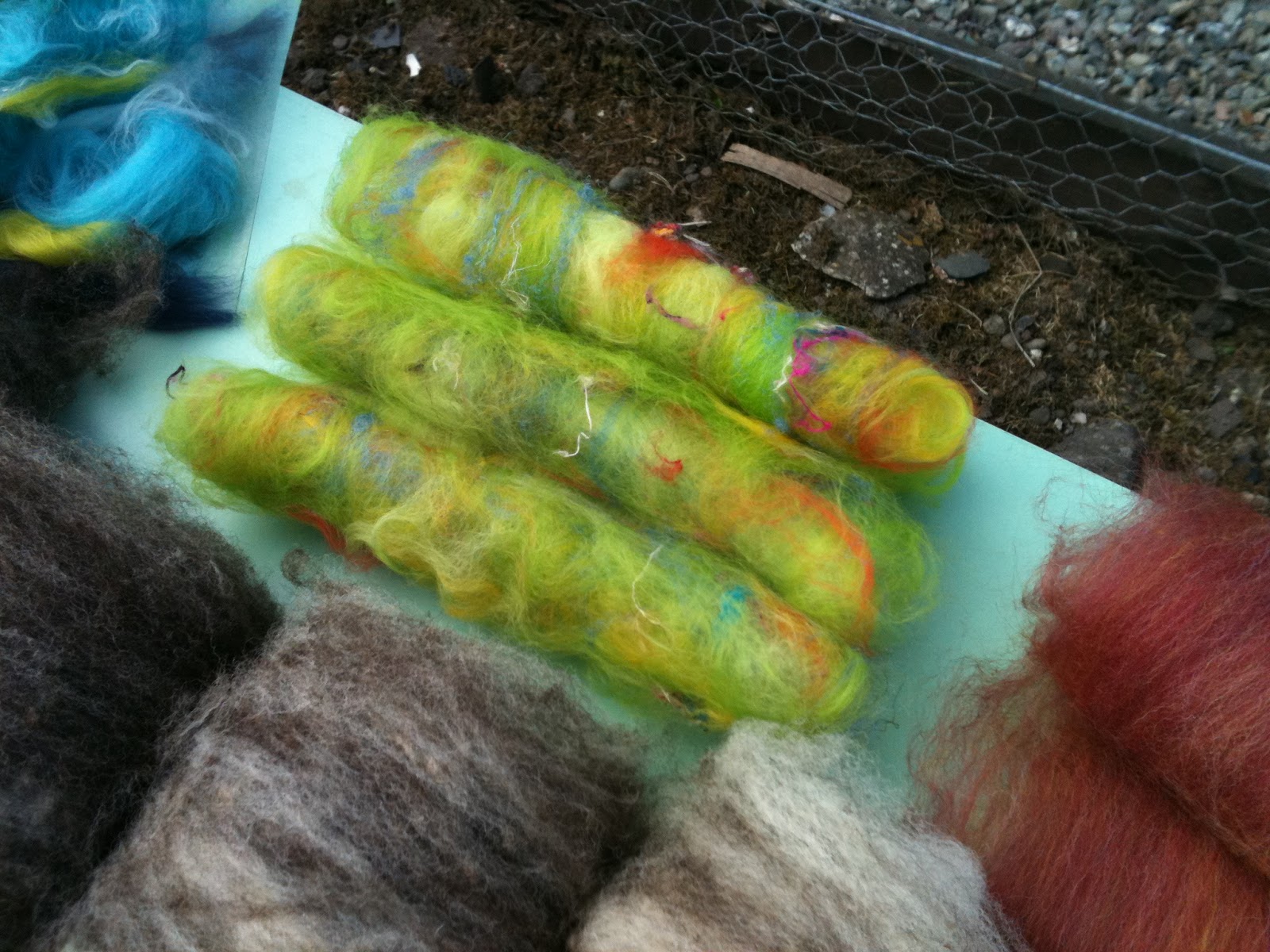
The third technique was again to take inspiration from an image, but this time to create a batt that combined the main colours and textural elements from the photograph, to produce art yarn. As well as more than a rainbow's worth of colored wool tops, I had brought along a big bag of fibres and yarns for adding texture - different kinds of silk, linen, angora, cut yarns, to name but a few. here are my examples:
and here's what was created on Sunday :
Aileen's spring meadow art batts
Linda's fabulous art yarn
Noreen's purple art batts with hand-dyed silk throwster's waste and recycled sari silk
mandy's misty woodland art batts
Fuelled by cake and a fab picnic lunch (thank you Aileen), and accompanied during the afternoon by fiddle music from the bigger hall next door (and more cake, thanks to the Over 60's Tea hosted by the Brownies!!) everyone accomplished much more than I expected in the time. Everyone did the techniques in a different order, but most managed to do all three during the workshop, which was a real achievement as the gradients and blends require repeated carding, someties as many as five times. It was a lot of work but a really fun colourful day and I'm looking forward to seeing the yarns that are spun from the boxes of carefully prepared batts that everyone took away with them.

Want to try these yourself?
I'll be repeating these workshops in the autumn, as well as a 'beginners weekend'. If you are interested, drop me an e-mail for  dates etc. I'm also planning a new 'menu' of workshops for next year., some really exciting ideas but I'm keeping them under wraps for now Right now, I'm off to pack my equipment for workshops in Miagliano (BI) next weekend, and then a short class in Venice the week after........then it's back to Perthshire for Fleece on the Hoof. See Workshops tab for details.