 |
| Dim Riv in the small boat harbour, Lerwick |
I cant believe I've been back from Shetland for a week now. I had such an interesting, fibre-filled and at the same time very laid-back time that it may take me a while to describe even just the highlights. I also took a huge number of photos, but I will try to pick out only the most interesting to post here.Another reason was that I have been a customer of Jamieson & Smith, the Wool Brokers in Lerwick for at least 30 years, buying fantastic quality fleeces and combed wool tops from them for spinning and some of their huge range of knitting yarns, but always by phone/post/internet. Having met Oliver and Sandra last year at Stirling, I was extra keen to visit them on their home ground. You can find them here: http://www.shetlandwoolbrokers.co.uk/ Combine those with my fascination with island life, and firmly held belief that no holiday is complete with out at least one boat trip (I had 10!!!) and it was irrisistible.......
 |
| Shared cabin on the Hrossey |
Shetland really is a very long way away - nearer to Norway than Scotland - so getting there is not quick or cheap. You can fly but I opted to go by ferry from Aberdeen, an overnight sail that lasts 14 hours. The crossings in both directions were on really calm seas (not always the case I understand) and the ships are modern, well equipped and immaculately clean. I sat in the lounge for a while (knitting of course!), watched 'The King's Speech' in the ship's cinema and then slept in my berth in a shared cabin till we docked in Lerwick.
Wednesday - my first ever day in Shetland
 |
| Jamieson & Smith's wool sheds |
I had deliberately arrived the day before the tour started to have time to get my bearings and start to think about what I might want to do for the few days after the tour. Here is the very first photo I took - the back of the Wool Brokers spotted while walking in to town from the ferry!!I resisted the temptation to go there straight away as it was a stop on day 1 of the Tour, but very quickly I discovered that Lerwick must have more yarn shops for its size than anywhere I've ever been! It also trades heavily on the textile heritage of the islands, with every conceivable gift item featuring sheep or made from or covered in either Fair Isle knitting, knitted lace or tweed. Lots of puffins and a sprinkling of vikings too. Sounds as if it could be a bit tacky but nearly everything I saw was nicely done, and there is a great deal of really good handcraft ranging from the ultra-traditional to more modern and funky designs.
 |
| The Peerie Shop signs |
One of the shops I found that morning was Da Peerie Shop which has a great selection of knits, gifts, their own range of great postcards and best of all, a cafe with home made cakes and good soup (as well as other goodies) - and outside tables, well used.
 |
| Lerwick, the stat of the Lodberries |
Fortified by morning and lunch-time visits to the Peerie Shop Cafe I spent much of the day pottering about in the centre of Lerwick. I discovered that it is my kind of town - interesting shops and lovely old buildings, huddled close together round the original docks and landing places called Lodberries, where hanseatic league traders and others did business in the 13th century and probably earlier, then climbing through steep lanes and alleys to broader streets, open spaces and substantial stone villas on the slopes above the waterfront.
 |
| Lodberries |
 Mid-afternoon it started to rain a bit, so although the Tour was starting there next day, I went for a visit to the Shetland Museum & Archive(http://www.shetland-museum.org.uk/). Housed in a fab new building beside a restored dock there is so much to see - this proved to be the firs of four visits and I am so glad that I did it in 'bite-sized' chunks. Bizarrely, as I was leaving a voice behind me called my name and I turned to discover three colleagues, in Shetland for a working trip, who had gone in for a coffee in the excellent cafe overlooking the waterfront.
Later, after a fish tea at the Fort Cafe I met up with Fiona, one of the trio, and we went to a music session in The Lounge. It was really good and the palce was packed, but eventually the long journey caught up with me and I had to go back to the B&B (Fort Charlotte) - and so to bed!
Thursday - Day 1 of the tour
I woke with the conviction that I just had to buy the knitting belt that I had spotted through the window of a charity shop the evening before. BUt the shop wasn't due to open till 10, which was also when I was to meet up with the rest of the Tour group, at the Museum. What a dilemma!!!
 |
| Knitting belt |
I could see the front of the shop from my bedrom window, and saw someone going in at about 9.30. The Closed sign was still up when I knocked on the door (several times!), but no-one answered. Slightly frustrated I went quickly to the Museum, where stting on a bench enjoying the morning sunshine I found our guide Andy Ross, and the other members of the group. Andy immediately put me at my ease, insisting that I absolutely should go back to the shop for the belt before someone else snapped it up! So once I had stowed my bag in the car, back I went as fast as my feet would take me. The shop was remarkably busy alread but I made a beeline for the belt, paid and hot-footed back to the museum. 10 minutes each way and once with baggage, I thought that's enough exercise for one day and all before half past ten! I was really glad to get the makkin' belt, as they are known locally. I've never knited with one but I had seen Sandra using one last year. They are used with long double pointed needles, the end of the right-hand (receiving) needle being stuck into a hole in the belt to steady it. This takes the weight of the knitting off he hands and makes the work quicker and the tension more even, apparently. As the work grows it can be wrapped in a cloth and tucked into the belt to take more of the weight. I could have got a new belt in several places in Lerwick but mine has been well used, and although I don't know who by or its story, it is nice to think that it has one.
 On my way to rejoin the group in the Museum, I met Amy, who was our tutor for a drawing / pattern workshop where we focussed on transposing one pattern element from the Fair Isle knits display into a different medium and background. This made us really look and think about pattern, something which stayed with me as the Tour went ahead.
 We had a break for a welcome cuppa and huge scones, before finishing our drawings.
On a background of printing ink I drew in brown oil pastel and then added smudgy stripes of grey and ochre chalk, which only stuck to the pastel, changing the effect to something much more subtle.
Next stop was the long-awaited visit to Jamieson & Smith, the Wool Brokers. Oliver showed us round the wool sheds explaining the special nature of Shetland wool, how it is graded and sorted and the difficulties facing the Shetland breed. Crossing with other breeds to give meatier lambs, and the government's scrapie scheme have left far fewer pure Shetland sheep on the islands, despite a recent increase in demand for the wool.
The 'inner sanctum' where the best pure Shetland fleeces were, in all the lovely natural colours, had me wishing I had brought more than one empty holdall to carry fleeces home! But, knowing that I would be back at the beginning of the next week to stock up, I reluctantly left them all where they were - for the time being. I think the grey fleece in the photo below (left) is one of the ones that will be going to Italy for my workshops in October.
 Oliver in the wool shed
Oliver showed us 'the scadder' (above)- a fleece with the primitive characterstic of a black mane of long fibres down the centre back - not separate guard hairs but wool fibres that extend as hair beyond the length of the normal staples.
.....and heres another fleece that is in my shed now!!
 We heard about the close links between the herring industry and knitting - way back, Shetlanders bartered knitted goods with Dutch and other fishermen who came to the islands, and in the days of the huge herring fisheries the gutter lassies knitted whenever they were not gutting fish (hopefully they washed their hands first!). In an old tin kirk from the fishing days, J&S have a display of fine lace knitting displayed with some herring barrel lids and Oliver's dad's herring net to keep the connection.
 |
| Old Herring net - and new wool carpets |
Recently J&S have started having the coarser wool made into carpets and rugs - the natural shades are lovely (no I'm not on commission!)
Upstairs in the shop we barely had time to glance at the knitting yarns in a huge range of thicknesses from cobweb to chunky and every colour of the rainbow. Sandra showed us the new worsted 2-ply kniting yarn they are trialling (they usually spin woollen) - it made the fair isle pattern in the sample very sharp. Louise the weaver-in-residence at the Centre for Creative Industries (on Yell) has been weaving with it and liked it a lot.
There was so much more to see that I practically had to be dragged out - but not before explaining my need for 6 fleeces, and that I would be back in a few days. I fetched my spare holdall from the car and left it there before we moved on.
We went to get supplies for a picnic lunch. Slightly surreally, sandwiched between a state-of-the-art leisure centre and a large Tesco are the remains of Clickimin Broch. And I've never been in a Tesco carpark with such a stunning view (Braewick). Inside was much the same as any other big Tesco, and just as busy.
 |
| Louise, Andy, Sarah and Pauline |
Heading south out of Lerwick we stopped for our picnic in a layby overlooking Catpund, with a view to Mousa and it's Broch. Our picnic was scented by the mint under our feet, and my eye being tuned in to pattern I spotted some interesting shapes in the wooden posts holding up the crash barrier.
 |
| St Ninian's Isle and tombolo |
Further south we went over to the west side of the island to the much photographed tombolo that connects St Ninian's Isle to Mainland.
 You would hardly expect such colours to work together- the fine pale sand, glassy turquoise sea and the rocks and lush grass of the island - there were only a few other people there, and it was very peaceful.
A piece of driftwood is a rare thing on a beach in Shetland, but the wind and tide create textures and pattern out of sand and shell fragments and what at first seems monochrome reveals surprising colours when you get up close.
 South again, just about as far as you can go on dry land, to Sumburgh Head to look at puffins. We did see some, but probably more puffin watchers! No shortage of kittiwakes on the very impressive cliffs though, and probably fulmar and other seabirds but I find some of them hard to distinguish. It was good to stretch our legs on the walk up to the lighthouse, where it was windy but not cold.
 |
| Puffins feeding young, Sumbugh Head |
Heading north (no other way to go from Sumburgh!) past alapacas (!!!!) we made for Hoswick and a cup of tea in the visitor centre there. Part of the building was previously a weaving mill and they have some of the old machinery and samples on display (and loads of old radios). Sarah, who is researching weaving on Shetland for her PhD, was amazed to learn that lots more samples had been dispersed for people to use - she will have her work cut out to track down that part of the history!
We visited Nielanell's studio/shop nearby, admiring her very innovative drapy machine knit wraps and garments. She also spins and dyes - very enthusiastic about indigo, and about solar dyeing with madder. Wonder if it is too late in the year to try that at home?
We had packed so much into the first day of our Tour and we still had to get to Yell where we were staying. We went via Tingwall and Voe but didn't stop till we got to Frankie's fish & chip shop (the most northerly.......) which had been highly recommended. Not many chippies have a verandah where you can sit and enjoy a view of the Voe, but we didn't have time to sit. We took our suppers in the car and made a dash for the ferry at Toft, just getting there in time to be the last car on. By then we were all so hungry that we stayed in the car and ate on the short crossing. The fish and chips were as good as promised, and we had several other opportunities to see Yell sound over the next three days.
Our B&B at Aywick is called Pinewood House - unusual name on a more or less tree-less island, but there was a warm welcome and a glass of wine and I never did get round to asking about the name!
Friday - Day 2 of the Tour
Andy picked us up after breakfast and we headed back to Ulsta for the ferry to Mainland Apparently there are often otters where the ferry comes in, but not today. From the boat I saw Gilliemots, gannets, cormorants and great skuas (called bonxies in Shetland) but no sign of the whales that had been spotted there a few days previously.
 |
| Margaret Peterson's hand-spin lace yarn |
Our first stop was at the home of Margaret Peterson, a lace knitter and spinner with a wealth of knowledge and experience, much in demand. However, before she shared it she wanted to know all about us - it was quite an inquisition! I'm sure we had just a many questions once we got on to the lace though. We covered preparing the wool spinning and plying, washing and stretching the yarn. The yarn was called 'wirsit', and as it is spun from combed locks it is worsted.
 |
| 'Crepe' shawl - hand spun and hand knitted |
After mugs of delicious home made soup and filled rolls we were shown sample shawls - small ones to show patterns and colours (stripes in the borders only, I much prefer the natural shades), also a beautiful example of a 'crepe' shawl, which I think she said was spun and knitted by her grandmother - no electric lighting in those days!
The centre is garter stitch, very elastic (hence 'crepe'). Apparently it was knitted from the outside in - edging and border worked in 4 pieces, with the fourth one continuing to make the centre and the sides of the other borders picked up to join. It has been stretched and blocked to make it very smooth, and shows off the even-ness of the spinning. It was a very interesting visit, not least hearing about her many travels to demonstrate spinning and trouble-shoot in some well known textile companies. We thanked Margaret for her hospitality and then headed to Lerwick for a cuppa at the Peerie Shop Cafe before going to pick up some cushions Andy had commissioned from a young weaver who has recently reurned to Shetland from art school. I spotted some photos of them today on the CCI blog (use the link at the top)- the weave and colourways are reminiscent of the 50's, with a lot of attention paid to using the colours to compliment the weave structure. As with so many things we saw being made or just finished, they were destined for the Tall Ships events.
 Our next visit was to Jamieson's mill at Sandness, over on the West coast of Mainland. This mill started in the 1970's and is now the last operational weaving mill in the islands. They dye and spin the yarn, the weave it into tweed and blankets or machine-knit Fair Isle - garments and yardage, apparently, as we saw a big pile of rolls of fair isle about a yard wide.
 Two of the looms were working while we were looking around the factory, and the carding machines added to the noise, while the dye vats made it warm and humid. We bought some lengths of un-fulled tweed (samples that didn't make it to the finishers as they decided not to proceed with that design) and some reject bits of fair isle knitting - both sold by weight. I'll write separately about what I have done or plan to do with all my aquisitions.
From the mill we drove by a different route back to Toft and the Yell ferry (just made it again!) and thenback to the B&B. After an excellent dinner at Pinewoods House I strolled around the scatter of houses that makes up Aywick, admiring the wealth of wildflowers, including some lovely orchids.
Saturday (Day 3 of the tour)
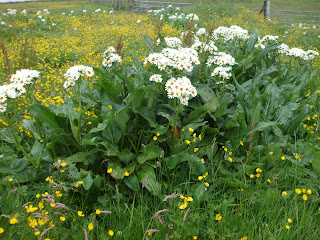 A day on Unst today, the most northerly inhabited part of the British Isles but lush, green and dotted with wildflowers. On or way to the ferry we stoped to pick up Louise at Sellafirth, where I spotted a very striking plant which I still cant identify.
 It is at last 60 cm tall, very sturdy loking and growing in big clumps near a ruined crofthouse. I can't help wondering whether it may have had a use as, for example, a dyeplant. It piqued my curiosity and I'd love to find outr what it is. It looks tough enough to survive the hoardes of slugs in my garden, so I'd love some seeds too!
 We took the ferry from Gutcher across Bluemull sound to Belmont on Unst and made straight for the Unst Heritage Centre. Rhoda welcomed us with a cup of tea, then showed us the display of lace knitting, for which Unst is famous. Many of the lace pieces in the display are recent replicas, as there are still a number of lace knitters on Unst guarding the patterns. There were also various items of spinning and knitting equipment in show including a replica sulphur smoke box used for whitening the yarn.
 We were privileged to also be shown a collection of original lace pieces, not on display to the general public as they ae so fragile, which were discovered in the abandoned shop in Uyesound with a letter dating fom the 1860's (I think). The work very fine and while some are badly damaged other pieces are in remakably good condition. No photos allowed though! Roda also showed us some very fine guage fair isle sweaters probably knitted for competitions pre-1920s, in cream with red and blue and ochre, and some use of moss stitch which struck me as unusual .
The Unst Heritage Centre has published a well researched and very interesting booket about the lace knitting, and transcribed one or two patterns - as they were never writn down before this is a mammoth task. However if/when I decide to knit the scarf pattern I bought I think I will chart it first, because the notation is particular to the islands, in which case I will make it available to the Trust. I have a lovely fine light grey Bluefaced Leicester fleece that might make a nice yarn for it ( and of course I now have some Shetland fleeces too which is what it was designed for!)
Rhoda told us a saying used in Unst as a invitation to a knitting gathering:
Lass tak dy sock an com an had de oot o langor
It means - bring your knitting and come and keep yourself from boredom - just so!!!
I could have stayed much longer as there was so much to see, not only about textiles but history geology and wildlife, but all too soon it was time to move on.
 We were rewarded by visiting the famous Unst bus shelter - the most northerly bus shelter, with all the comforts of home, regularly re-decorated by a local lad (or his Mum if he's away), and predictably done out with a Tall Ships theme. Loads of work had gone in to it with applique'd curtains and cushions and nautical pictures added to the furnishings.
  Lunch was at The Final Checkout - a rather ominous name for the (predictably) northernmost shop, cafe and (I think) post office in Britain.
Like several of the shops in more rmote areas it is in a corrugated building that looks more like an agricultural building.
 Next we went to the Unst Boat Haven, which, as the name sugests houses a colection of restored boats incluing the Far Ha'af - a traditional Shetland sixareen (six oared boat). Far ha'af is the term for the distant deep water fishing grounds where these boats worked for weeks at a time. I like the effect of worn layers of paint on some of the boat hulls and oars - sometimes the colour cobinations that work are quite suprising
 We went to a small bay where the beach is composed of serpentine pebbles. My ancient trainers were too smooth-soled for the steep clamber down so I walked across the small headland to look at the next bay, where I spotted an otter fishing among the seaweed and rocks at the water's edge.
 After calling the others I watched it for several minutes until, after obligingly lying on its back in the water to eat something, it disappeared from view. We had parked beside a small talc quarry, and were much taken by the pattern of tracks in the dried talc-mud at the edge of the workings,
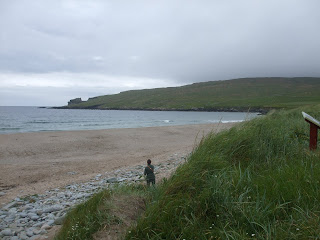 Next stop was the beautiful sandy beach at Norwick, almost as far north as you can get, and completely deserted. We ate cakes from the Final Checkout, tried fairly unsuccesfully to collect a small amount of lichen from the rocks for dyeing, and beachcombed. Then it was time to visit the chocolate factory (well, you just have to...!) - in part of the former RAF base, still with a certain amount of RAF memorabilia among the chocolate.
  At one point on our travels around Unst we stopped to look at a replica viking longship that had been sailed across from Norway but never taken back. A small wooden visitor centre in the shape of a longhouse is being built next to it. The view across the bay (Haroldswick) is lovely
 While waiting for the ferry at Belmont we played on the 'plinky boat' - a small boat hull with copper pipes set up inside it like a xylophone. It certainly kept us big kids amused until the ferry arrived. Back at Gutcher (Yell) our very full day was rounded off by a delicious dinner cooked by Maggie and Andy and eaten surrounded by Andy's eclectic collections of art, textiles, music, ceramics, turtles...... and some strange japanese algae in a tank vase. After dinner, a glass or two of wine and good company, it was time to go back to Aywick for our last night in the B&B.
Sunday - Day 4 of the Tour
Our last day on Yell involved more hands- on workshops. After picking up Louise and saying godbye to Sarah, who had too much work to do to be able to join us, we went to the Centre for Creative Industries at Sellafirth.This light and airy building houses several looms, and at last we were able to see the lovely soft scarves that Louise has been weaving (for the Tall Ships, of course). We were joined by Sarah Hoseason a very enthusiastic art teacher who spoke about sources of inspiration and metasaga. She gave us a workshop on bonded fibres.
 The technique is between paper making and felting, relatively quick and satisfyingly messy at the final stage. What I produced that morning was a squidgy and slightly slimy parcel that had to be carefully transported, first to Lerwick and then eventually back home, where it took several days to fully dry out and produce a piece roughly 30cm square, reminiscent of sand that has been recently uncovered by the tide, with a tangle of washed up flotsam.
A short walk from the Centre is Bayanne House and the studio workshop of Liz Gott who makes knitted landscapes. She uses photographs for inspiration then meticulously builds up a chart using a computer programme, then machine knits, before stitching, stuffing, embellishing and sometimes painting the surface. The pieces are framed in driftwood. Liz also uses an embellishing machine to make felt pieces and demonstrated it. As none of us had seen one in action before we were very impressed - in fact I hope she didn't get the impression that we were more excited by the potential of the embellisher than by her work!!
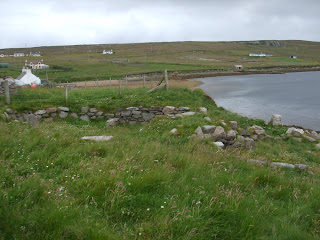 Just behind Liz's studio, past geese, goats, hens, ducks, veggies and tatties is the site of a neolithic settlement, the remains of three houses have been found, others may have fallen into the bay as the small cliff has eroded over many centuries. A beautiful peaceful spot with the profusion of wildflowers that so impressed me all over Shetland.
Tea and very good cakes at the Old Haa museum at Burravoe, where there was an exhibition of densely embroidered seascapes by Shona Skinner, almost hyper-realistic, like photograph from a distance, the texture is only apparrent close-up. Andy had already oughtthe one i would have chosen, oh dear!!
We moved on to the studio of Pauline Walsh, who makes a huge variety of felted items, from beads, balls and rattles to bags, felted knitted scarves..... Her purpose built studio overlooks the beach where she gathers materials for a shingle garden. We did a needle-felting workshop, building up balls of felt over rattles made of cockle shell pairs glued together with a small pebble inside. Except for Andy who made a frog! It was nice to sit and chat while doing the rather mindless needlefelting and not to much blood was spilt!
 On the ferry back to Mainland Andy gave each of us a lovely knitted lace scarf from J&S as a memento of what had been a fabulous four days. We were very quiet on the way back to Lerwick - I for one had loads to think over, loking back at all of the places we had been, things we had seen and done, and people we had met and shared stories with. Writing i al down, it seems as if we were madly rushing aroud and on the go all the time, but although we did and saw al the things I have described, and more, and covered 500 miles, it was actually a very relaxing and laid back time, as well as a fascinating and inspiring experience.
The B&B I stayed in that night, and for the rest of my stay, Christine's Place, was just a few steps (literally)up the (very steep) road from the one I stayed in when I arrived in Shetland. Pauline and I ate in the Grand Hotel that evening - a bit gloomy with decor and menu stuck somewhere in the 70's. I spent the rest of the evening considering what to do with the rest of my time in Shetland, while kniting a sock gusset (as you do!). Then I started reading a bok that was on the shelf in my room, Memoirs of a Lerwick Lad, which kept me fascinated for an hour or so each night for the rest of my stay.
Monday - day 6 of my Shetland adventure
 I wandered down to the quay after breakfast just to see the times of the Bressay ferry, and a sit was about to leave, decided to go aboard.
  I spent a peaceful, quiet day on Bressay - it is so close to Lerwick but feels like another world. I think I saw eight people in the whole time I was there.
  The Bressay Heritage Centre is closed on Mondays - if I had known that I would have gone on Tuesday! So I walked round to the little village of Maryfield, which has an immaculate graveyard, and one shop (the Mail shop?) where I was able to get a pre-packed sandwich, juice, yoghurt and a bar of chocolate for lunch. It made me think of the shop in Little Britain......
 From the shop steps I spotted an small but enticing sandy beach and headed towards it. I didn't quite get there but found a shingle beach instead where I had my lunch and spent a couple of hours beachcoming for sea-glass.
 After a while I noticed that I had also found several fragments of sea-worn Willow Pattern china - some with only the faintest traces of pattern remaining. The more I looked, the more of it I found and the idea for a mixed photographic, knit and jewellery collection started to form .... watch out for 'Traces of Bressay......
 Eventually I started to head back towards the ferry pier, and almost immediately came upon a much longer stretch of sandy beach! As I was in no rush to go back and there are plenty of ferries between Bressay and Lerwick, and no beaches at all at home, I stayed on that one for a while too. This photo has some of the elements I was looking to include in my bonded fibre piece.
 On the way back to the ferry I passed a solitary fat seal in the little harbour, who shifted just enough to watch me as I walke along the sea wall beside the road. Probably the only eye contact I had on the island in the 5 hours or so that I was there!.
  At the crest of the rise the wall beside the road was so thickly covered in lichen that I felt no compunction at all in collecting some for dyeing.If the ferry hadn't been about to leave I would have collected more, but I have enough for a test, and if it is good I will consider the £4.10 return fare on the ferry a good price for some dyestuff, next time I am in Shetland.
On board the ferry I chatted to the only other foot passenger, a man from Paisley now living on Yell, supporting his life as an artist with a cleaning job in Lerwick (nice commute, beats the A90 to Dundee, but maybe not such fun in bad weather. But then neither is the A90..) He had whizzed past me on a bike while I was gathering lichen but had the grace not to as what I was up to scraping at a drystane dyke!
Later I had a fish supper on the quay under the beady eye of a very large herring gull (who did't get any, they are such a nuisance) and then walked along to the Lodberries where a group of children, around 10 years old, were having a sailing lesson in small yellow dinghies. On my way back I spotted a skein reel in the window of the 'Collectables' shop and decided to investigate in the morning. Not very practical for transporting but.......!
Tuesday - day 7 in Shetland
A day for errands - I had even made a shopping list when I set out in the morning! Top priority- I needed to replace my knitting needle! The wooden tip of the 2mm circular needle I was using for the Sottopassaggio sock had snapped under the strain of 4 cable twists, all knitted into the back of the stitch, between two more tbl stitches and an increase (also tbl) - all in the space of 13 stitches! (Any non knitters reading this would be best just to ignore that last bit and not try to understand it - the da Vinci code has nothing on knitting! (and is a lot less interesting!). Explaining why I needed a very thin but very long circular needle - for magic loop - resulted in me giving a quick demonstration of said technique, which I favour for socks or gloves especially when travelling. They were cooking Shetland Fudge downstairs and the yarn shop was warm, slightly humid with a delicious hot fudge aroma. The yarn shop lady dropped tantalising hints about a Bergere pattern for sideways knitted socks, but didn't have a copy in stock. Lots of interesting yarns and knitted samples to show them off.
By the time I had finished here it was time for the 'Collectables' shop to be open. I had a good look at the skein reel and decided to buy it despite the obvious impracticalities of getting it home by ferry and train.
 I may have to make a small adjustment for it to take the 2 metre skeins of yarn that I make, but it won't be far off - the standard skein of lace yarn in Shetland was 2 yards (at 100 threads per skein). Like the makkin belt, the reel has a story of its past use - although the shopkeeper didn't know anything about its origins. I have seen similar reels in the Shetland Museum and the Unst Heritage Centre as well as in illustrations in various books. I was delighted with my purchase, an added bonus is that it cost £60 less than the new umbrella swift I was planning to buy for the same purpose - my Granny's swift is a bit wobbly and slows the winding down considerably.
In Anderson's Shetland Warehouse it was like stepping back to the 1960's apart from the Noro yarns display in the window and a Tall Ships themed one in the other. I got Fair Isle wrapping paper for covering my pattern files and design notebooks. Then, as my daughters seemed convinced that I was going to bring a sheep back from Shetland, I bought one in the Peerie Shop. Actually it is a nylon wind sock made in China, but still a sheep!
I went back to the B&B to drop off my purchases before making my third visit to the Museum.
 In the 'Tea and Ships' exhibition in Da Gadderie there were a couple of pieces of Willow Patern china which I photographed to add to the 'Traces...' collection.
 There was also a Victorian tea room - where all the cakes and biscuits were knitted! Look closely - they are really very good and I bet many of the Museum's visitors didn't notice!
 Re-visiting the textile collection I discovered drawers in the display cabinets which have many more items,including a collection of fine lace shawls, one in a nice variant of print o' da wave stitch. The musem shop had more fair isle wrapping paper and a lace design so my files will be very smart! I bought several postcards too, as my photos have reflections from the glass cases.
I had a good lunch in the Hay's Dock cafe, upstairs in the museum, then it was time for the most important business of the day - sorting out my fleece purchases at the Wool Brokers! When I got there Sandra greeted me with 'Are you da fleece wifie?' (I really shouldn't have told my daughters that bit - it has stuck!)
 After telling me that they had terrible news for me (I couldn't imagine what, they had had plenty of fleeces when I was there on Thursday) she said that Oliver 'being the Viking that he is' had broken the zip on my holdall!!!! Then she went of to find him, and I heard her telling him that I was terribly upset and crying - which I wasn't at all!! Actually just a bit of the stitching had give way which will be easily mended. Oliver had looked out some lovely fleeces but some were not the colours that I wanted, which gave me the chance to go and choose the ones I really wanted my self
 .
. It was so difficult to only choose 6!!! I was like a kid in a sweetie shop, but eventually I had made my selection.
I was gratified when Oliver came in with someone else he was showing round, picked up one of the fleeces I had chosen, and said that it would have won top prize in any show. Having also chosen several kilos of clean, combed tops I made arrangements for two big parcels to be sent direct to Italy for spinning workshops that I will be giving in Lucca and Sardinia in October. For each workshop I picked a moorit fleece and a grey one, and combed tops in white, black and fawn. I also bought home with me two more fleeces -light moorit and very pale blue-ish grey, and fawn and white combed tops, as well as a set of the long double pointed knitting needles that you use with a makkin belt, and the cockleshell scarf pattern. Oh, and a poster with all the colours and markings of Shetland sheep. I love the soft natural coloured blankets woven on named crofts that they have but that will have to wait for next time.... I only took one empty holdall with me (but a big one!), maybe next time I'll take two!
From the Wool Brokers once I could tear myself away, I waked along to the Bod of Gremista, which is out past the ferry terminal and the power station. NOt the nicest part of Lerwick for walking but it was a dry sunny day. At the Bod the local Guild of Weavers, Spinners and Dyers have a Textile Museum. As well as the (by now) expected collection of Fair Isle and Lace knitting they have displays of members' work and two or three times a week someone is there to demonstrate spinning. When I was there three people were knitting Fair Isle, all using makkin belts, and I had a chance to ask more about using one. There was also a Tall Ships themed display including some things that members had knitted for the last visit of the TS in 1999. BecauseI was so interested in the displays and in talking to the people there I seem to have forgotten to take any photos!
 |
| Hay's dock - part of the Museum |
On the way back to town I called in to the Shetland Museum again for a look in the boat shed and the excellent museum shop. I was hoping to get a copy of a book called 'Knitting by the fireside and knitting on the hillside' by Linda Fryer, but it is out of print. (When I looked on Amazon later a second-hand copy was £95 - must tell Andy as he has one - so I have requested an inter-library loan at my local library, it will probably come from Shetland Libraries!!). Then back to the B&B on tired feet, for a 'wee sit down and a nice cup of tea'.
Wednesday - my last day in Shetland, for now....

A calm and sunny day, so I walked out past the Lodberries, Anderson's Homes (for widows) and the High School with its hostel for pupils from further away, to the Knab. Tis rocku promontory, occupied by the cemetery, golf course and dog walkers, faces south down Bressay sound and I am sure that in the distance I saw a Tall Ship heading north to Cullivoe (Yell), where the TS were to spend a few days before going to Lerwick. A seal was lazing in the water and huffing from time to time - when another one swam up he started a noisy howling so it went away. Gannets were diving for fish as I walked further out towards the point. Another seal, lying on a small rock just below the water, was noisily defending its perch from three or four other ones - clearly there was only room for one!
Back to the B&B, to collect my stuff. Chistine and Jamie kindly gave me a lift to the ferry, via the Wool Brokers to pick up my big bag. havingpit my overnight things into a small bag I handed over two big holdalls before going aboard the Hjaltland. Actually the ferries are so similar dont think I realisd it was not the Hrossey until we arived in Aberdeen next morning!
 It was a lovely clear and (more importantly) completely calm evening, and we passed quire close to Fair Isle, basking in the evening sunshine. Even at that distance you could see flocks of seabirds circling round the cliffs.
 A few hours later we reached Orkney and called in at Kirkwall for about an hour to unload and load more passengers and vehicles. The photo was taken at about 11.00pm, 3 weeks after mid-summer. The shetlanders call the period when it doesn't get dark at night the 'simmer dim'.
So, that is the end of my Shetland saga, and if you've managed to read this far you deserve a medal. While my time, especially during the tour, was packed with interesting things to see and do, it was also hugely relaxing and refreshing. I came away with about three times as much luggage as I took, a notebook and head full of ideas and inspiration, nearly three hundred photographs as sources of colours, patterns and reminders, loads of information about historical and contemporary textiles, great respect for the people who live so creatively in such a remote and beautiful place, and best of all an invitation to return which I shall certainly take up.


