Interest is mounting in the workshops we are planning for Lucca and Milan in April. There are still a few places available for all the workshops, but I am limiting the number of places to ensure that everyone has the best opportunity to learn. Full details are in the post two down, on this blog - with a link to dettagli in italiano.
In each city we are offering three workshops: Fibre Preparation, drop-spindle spinning and spinning wheel basics.
In the Fibre prep workshops we will be starting with a fleece, just as it was shorn from the sheep, and learning how to sort the wool and prepare it for spinning. We are hoping to be able to use native Italian fleeces. We will also look at blending different colours of wool, and preparing some more exotic fibres.
Drop spindle spinning is a great way to learn the essential processes of spinning, whether you want to progress to a spinning wheel or continue to develop your skills using a spindle. Shetland combed tops (wool) will be provied for use in this and the spinning wheel workshop, or you can spin the fibre you have prepared yourself.
The spinning wheel basics workshop will cover the whole process of spinning a yarn on a wheel. We will be using scotch-tension wheels but other types will be discussed. If you have a wheel, bring it (and get a 15% discount!), wheels will be provided for use by those who dont already have one, but they will have to be shared.
We are offering an optional 'menu' of equipment which can be pre-ordered - you can then learn how to use your own equipment during the workshop and won't have to share.
In Lucca we are being hosted by the lovely Lucca Centre for Contemporary Art, and in Milan by Paola della Pergola. There is a price difference because in Milan the Fibre Prep and Drop-spindle workshops will be longer, and also there is an additional charge towards the cost of the venue there.
Sunday, 6 February 2011

Busy Sunday! and chocolate panetone
Today I've been dyeing two more sushi rolls (see earlier post) - this time I used the dye powder direct on the soaked knitted strips, and used 2 - 3 times as much dye as for the first two.
Sushi roll 3 had Sun Gold, Moss green and Mail red
The colours are certainly stronger than before, but a lot was still lost in the rinsing.
For Sushi roll 4 I tried adding vinegar - although the dye is supposed to be complete i.e. with acid, I wondered whether more would help the dye to take. After soaking for a couple of hours in water I put the strip into 1part vinegar to 5 parts water for about 10 mins. Also one of the dyes was in hard lumps so I dissolved it in about 10ml vinegar, microwaving for 30sec to heat it.
Colours used: Turquoise, Purple and Malachite (the lumpy one).
I'll photograph and post once they are dry.
I have enough Omega dye left for 3 or 4 more rolls, so watch out for future posts.....
As both daughters were at home I made a chocolate panetone in the breadmaker for breakfast
 Delicious, especially warm with coffee. Not too sweet and just chocolatey enough, with some littlee 'nuggets' of extra chocolate. Here's the recipe. Put everything in the beadmaker in the order listed the night before and set the timer so it's ready at breakfast time!
180 ml warm water
55g butter, cut up into small bits
2 eggs, beaten
1 tsp vanilla
1 tbs sugar
2 tbs dried milk powder
1 tsp salt
450 g whte bread flour
1 tsp dried yeast
80g dark chocolate chopped into small pieces (I used Green & Black's 70% cocoa)
Set the timer and wake up to a delicious aroma!
If you're not making it overnigh, add the chocolate at the beep and it might be in more distinct choc chips.
Tonight, as there was some left (to my surprise!) I made a lovely bread-and -butter pudding with almonds and raisins
Sushi roll 3 had Sun Gold, Moss green and Mail red
The colours are certainly stronger than before, but a lot was still lost in the rinsing.
For Sushi roll 4 I tried adding vinegar - although the dye is supposed to be complete i.e. with acid, I wondered whether more would help the dye to take. After soaking for a couple of hours in water I put the strip into 1part vinegar to 5 parts water for about 10 mins. Also one of the dyes was in hard lumps so I dissolved it in about 10ml vinegar, microwaving for 30sec to heat it.
Colours used: Turquoise, Purple and Malachite (the lumpy one).
I'll photograph and post once they are dry.
I have enough Omega dye left for 3 or 4 more rolls, so watch out for future posts.....
As both daughters were at home I made a chocolate panetone in the breadmaker for breakfast

180 ml warm water
55g butter, cut up into small bits
2 eggs, beaten
1 tsp vanilla
1 tbs sugar
2 tbs dried milk powder
1 tsp salt
450 g whte bread flour
1 tsp dried yeast
80g dark chocolate chopped into small pieces (I used Green & Black's 70% cocoa)
Set the timer and wake up to a delicious aroma!
If you're not making it overnigh, add the chocolate at the beep and it might be in more distinct choc chips.
Tonight, as there was some left (to my surprise!) I made a lovely bread-and -butter pudding with almonds and raisins
Friday, 28 January 2011
Spinning Workshops in Italy - April 2011
Per dettagli in Italiano, vai qui:
http://knitviktim.blogspot.com/2011/01/workshop-di-filatura-lucca-e-milano.html
At last I can post details of the spinning workshops that I will be giving in Italy in April. With help from local friends, we are planning 3 workshops in Lucca and 3 in Milan
Here are the dates and prices:
Lucca
All specialist equipment and materials are supplied (you can bring your own carders, combs or fibres if you have any)
Lucca
Lucca


http://knitviktim.blogspot.com/2011/01/workshop-di-filatura-lucca-e-milano.html
At last I can post details of the spinning workshops that I will be giving in Italy in April. With help from local friends, we are planning 3 workshops in Lucca and 3 in Milan
If you have any questions about the workshops, please leave a comment, with your contact details (e-mail address) so I can get in touch with you.
Here are the dates and prices:
Date | Duration | Cost | ||
Fibre Preparation | Sat 9 April morning | 3 hrs | €50 | |
Drop-spindle spinning | Sat 9 April Afternoon | 3 hrs | €50 | |
Spinning Wheel basics | Sun 10 April | 5 hrs | €80 | |
MILANO | ||||
Fibre Preparation | Sat 16 April | 5 hrs | €80 + €25 room hire | |
Drop Spindle spinning | Sun 17 April | 5 hrs | €80 + €25 room hire | |
Spinning wheel basics | Mon 18 April | 5 hrs | €80 + €25 room hire |
The Lucca workshops will be in the Lucca Centre for Contemporary Art (Lu.C.C.A) which is a lovely venue within walking distance from the train station.
The Milan venue is still to be confirmed.
Here are some details of what the workshops will cover:
Fibre preparation workshop
Milano: Saturday 16 April. 5 hours (plus a 1 hour break for lunch (not included in the price))
€80 + €25 room hire per person

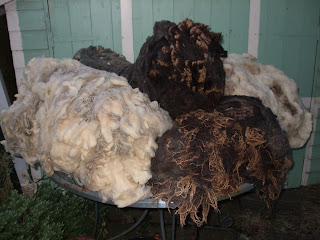
Some lovely new fleeces which arrived yesterday!
All specialist equipment and materials are supplied (you can bring your own carders, combs or fibres if you have any)
Please bring: a washable apron, a cloth bag e.g an old pillowcase, a box with a lid (e.g. a shoebox)
As we will be using unwashed wool you might prefer to wear latex or rubber gloves but these are not really necessary
This workshop is for people who have little or no experience of preparing fibres for handspinning. We will spend most of the time preparing a raw sheep’s fleece, which will be shared between the students. We will also look briefly at preparing other fibres such as silk, and if time allows we may also touch on blending fibres
Handcarders and combs are relatively inexpensive tools and easily portable so we will use these in the workshop. We will discuss the use of drumcarders. (If anyone can bring a drumcarder, let me know, as we can incorporate a practical demonstration)
The workshop covers:
A look at fibres:
- What makes wool so good to spin?
- What other kinds of fibres are available for spinning
- Pre-prepared fibres: Carded or combed, tops, roving or sliver
- Storing raw and clean fibres
Sorting and grading wool from a raw fleece
Carding wool by hand
Combing wool staples
Preparing silk from caps and cocoons
(Blending fibres ) – if time allows
You will be able to take away the fibre that you prepare during the workshop.
............................................................................................................................................................
Beginners’ Drop-spindle spinning workshop
Milano: Sunday 17th April. 5 hours (plus a 1 hour break for lunch(not included in price)) €80 + €25 room hire per person
Equipment and materials supplied (bring your own if you prefer)
This workshop is for people who have little or no experience of handspinning. It gives a good foundation for people who want to learn to spin using a spinning wheel, and is also suitable for those who intend to continue to develop their skills with a drop-spindle.
A drop spindle is a simple, inexpensive and very portable tool which can be used to produce a huge variety of yarns. With a spindle, we can slow the spinning process right down so the learner can develop a good understanding of what needs to happen during the spinning process, and how to control it to produce good quality yarns. This is directly transferable to spinning with a spinning wheel.
The workshop covers:
A look at fibres:
- What makes wool so good to spin?
- What other kinds of fibres are available for spinning
- Pre-prepared fibres: Carded or combed, tops, roving or sliver
Types of spindles
Getting started – spinning a singles yarn
Thickness and twist
Plying – why and how
Finishing yarn – setting the twist
Measuring thickness and quantity, and comparing with commercial yarns
You will be able to take away the wool that you spin during the workshop
.................................................................................................................................................................
Spinning Wheel basics workshop
Milano: Monday 18th April €80 + €25 (room hire) per person
5 hours (plus a 1 hour break for lunch- not included in the price)
Equipment and materials supplied (10% discount if you bring your own spinning wheel – please let me know in advance what type it is)
This workshop is for people who may have tried spinning with a drop spindle, but who have little or no experience of using a spinning wheel. If you have already learned the basics of using a drop spindle you will get on better in this workshop, but it is not essential.
This workshop gives you the skills for spinning a wide variety of yarns using a spinning wheel, we will spin wool but you will also get a good foundation for continuing to develop your skills with other fibres.

Ashford Traditional spinning wheel Ashford Kiwi spinning wheel
Modern spinning wheels are versatile and robust, they are much easier to use than antique spinning wheels which often have parts missing or broken, and were often made for spinning one specific type of yarn
The workshop covers:
A look at fibres:
- What makes wool so good to spin?
- What other kinds of fibres are available for spinning
- Pre-prepared fibres: Carded or combed, tops, roving or sliver
Types of spinning wheels
Getting started – spinning a singles yarn
Thickness and twist. Twist ratios and band tension
Plying – why and how
Finishing yarn – setting the twist
Measuring thickness and quantity, and comparing with commercial yarns
You will be able to take away the wool that you spin during the workshop
..................................................................................................................................................................
Optional extras only available for workshop partcipants
‘Student’ drop spindle €7
72pt curved Carders €39 per pair
Niddy Noddy €18
Ashford Kiwi spinning wheel €295 ) Ashford spinning wheels come with
Ashford Traditional spinning wheel €385 ) spare bobbins and Lazy Kate
Shetland wool combed tops – natural colours €3 per 100g
Shetland wool combed tops – dyed €4.50 per 100g
(see http://www.shetlandwoolbrokers.co.uk/ for colours)

Carders, niddy-noddy and drop spindles
................................................................................................................................................................
Teaching will be in a mixture of English and Italian. Translators will be on hand to help with any language problems. I have over 25 years experience of teaching spinning in the UK
Places are limited to 8 for Fibre Preparation and Drop-spindle spinning workshops, and 5 for spinning wheel basics workshops. Equipment will be provided but will have to be shared - if you choose to purchase equipment from the 'optional extras' listed above you will not have to share it.
If you have any questions about the workshops, please leave a comment, with your contact details (e-mail adress) so I can get in touch with you.

Sunday, 23 January 2011
How green is my halo!!! and a recipe for stollen
I've had a day of recycling - smug? moi??!!!!
This morning I recycled the christmas tree in to weed-supressing mulch for the paths in my vegetable garden. Yes, I know christmas was about a month ago, but until a week ago the paths, like the rest of my garden, were under a thick layer of frozen-hard snow, and I would have needed a pickaxe to get at them. And last weekend it poured with rain non-stop... which at least got rid of the snow. First time I'd seen grass in my garden for 7 weeks. The garden is looking very sorry for itself, but no doubt it will recover. I hope the garlic (from Gubbio in Umbria) and jerusalem artichokes are ok under the still-frozen ground. The kale, purple sprouting broccoli and swiss chard plants all look as if someone has sat on them, but once it warms up a bit I expect they will shoot again.
I tried the christmas tree mulch on one path last year, and it certainly did seem to work, fewer weeds and a pleasant surface to walk on (although I wouldn't try it with bare feet) so today I snipped the smaller branches into bits about 6" long, or less, and spread them on another path, treading them down. One 4' christmas tree only produced enough mulch for about 6' of path, but what is left (the central trunk) will be much easier to dispose of. If I had an open fire or stove I would burn it but it would be very sparky, and anyway I dont, so it will go in the green recycling bin to be shredded and composted by the council .
I also tidied up about two months of stuff destined for the compost heap - when the ground was covered in snow I couldn't get to the compost bin so all the (biodegradable) bags of veg peelings, dead flowers etc had been piling up in buckets outside the back door. At least the cold weather prevented it from smelling!
After lunch I spent a couple of hours recycling two old duvet covers into eight large cloth sacks. I did this because in the next week or so I am expecting a delivery of fleeces, and cloth bags are much better than polythene for storing them. The big bags are useful for storing loads of other things too- they are tougher than bin bags, good for wrapping and cushioning awkward shapes, and of course they are washable and reusable.
Finally - I 'recycled' (well, used up) the marzipan left over from the christmas cake by making two stollen. I modified the recipe to use my breadmaker for the dough, then baked them in the oven.
Tastes as good as it looks!!

Here's the recipe:
This morning I recycled the christmas tree in to weed-supressing mulch for the paths in my vegetable garden. Yes, I know christmas was about a month ago, but until a week ago the paths, like the rest of my garden, were under a thick layer of frozen-hard snow, and I would have needed a pickaxe to get at them. And last weekend it poured with rain non-stop... which at least got rid of the snow. First time I'd seen grass in my garden for 7 weeks. The garden is looking very sorry for itself, but no doubt it will recover. I hope the garlic (from Gubbio in Umbria) and jerusalem artichokes are ok under the still-frozen ground. The kale, purple sprouting broccoli and swiss chard plants all look as if someone has sat on them, but once it warms up a bit I expect they will shoot again.
I tried the christmas tree mulch on one path last year, and it certainly did seem to work, fewer weeds and a pleasant surface to walk on (although I wouldn't try it with bare feet) so today I snipped the smaller branches into bits about 6" long, or less, and spread them on another path, treading them down. One 4' christmas tree only produced enough mulch for about 6' of path, but what is left (the central trunk) will be much easier to dispose of. If I had an open fire or stove I would burn it but it would be very sparky, and anyway I dont, so it will go in the green recycling bin to be shredded and composted by the council .
I also tidied up about two months of stuff destined for the compost heap - when the ground was covered in snow I couldn't get to the compost bin so all the (biodegradable) bags of veg peelings, dead flowers etc had been piling up in buckets outside the back door. At least the cold weather prevented it from smelling!
After lunch I spent a couple of hours recycling two old duvet covers into eight large cloth sacks. I did this because in the next week or so I am expecting a delivery of fleeces, and cloth bags are much better than polythene for storing them. The big bags are useful for storing loads of other things too- they are tougher than bin bags, good for wrapping and cushioning awkward shapes, and of course they are washable and reusable.
Finally - I 'recycled' (well, used up) the marzipan left over from the christmas cake by making two stollen. I modified the recipe to use my breadmaker for the dough, then baked them in the oven.
Tastes as good as it looks!!

Here's the recipe:
Breadmaker Stollen (makes 2)
100ml warm water
2tbs dried milk powder
1 egg
300g plain flour
50g icing sugar
Zest of half a lemon
pinch of salt
1 tablespoon brandy
50g flaked almonds
50g butter chopped up small
100g raisins
1 tsp dried 'quick' yeast
150g marzipan
Put everything except the marzipan in the breadmaker, in the order given, and set it to the dough programme.
When the dough is ready, tip it out on to a floured surface. Cut it in half. Stretch each piece into a rectangle about 12 inches by 8.
Make the marzipan into two 'logs' 10 inches long. Place in the middle of the dough rectangles and wrap the dough round them, pinching the ends.
Place on a non-stick baking tray and bake at 180 C for40 mins. Enjoy!!!
Sushi adventures
The continuing perfect weather for spinning and knitting has given me the opportunity to start a project that I have been planning for a while - creating 'sushi rolls' for knitting socks, shawls or other items with unusual dye effects.
Its not an original idea - I should give credit to Jon 'easyknitter' Dunne who creates gorgeous individualy dyed yarns. Check out the easyknitter website....
I decided to have a go at making sushi rolls myself when a) friend gave me an old knitting machine and b) I aquired a large cone of very fine white yarn of unknown fibre content, for £1 in a charity shop. The third necessary element (time) was supplied courtesy of yet more snow making it impossible to go and visit my stepfather in Oban (again).
First step: getting the knitting machine to work.
My mum had a similar machine, rather more basic, in the 1970's, and I had some vague memories of how to use it.Luckily my friend had also given me the instruction manual, so once I had given the machine a fairly cursory cleaning I followed the setting up instructions (with some trepidation) and gave it a go - bingo!! It worked perfectly!!!
Next step: figure out how much yarn to knit for each sushi roll. As the rolls are usually made for knitting socks, I figured that the length of yarn in a ball of sock yarn should be the minimum to aim for - 420 m in 100g ball of Trekking.
My white yarn was much finer than sock yarn, so I based all my calculations on using it double.
As long as each sushi roll contains 130g double yarn (before dyeing) there should be more than enough to knit a pair of socks, or any other project that can be knitted from a 100g ball of a standard sock yarn.
Winding the yarn was a fairly time consuming and tedious process, but the knitting went fairly quickly. It must be good exercise for the upper arms and pecs - bye bye bingo wings!!
I knitted 4 strips to experiment with -

Imagine how long that would take to knit by hand - each one took about 20 minutes on the knitting machine!!
I also knitted a mini sushi strip as a sample = first for pressing, then for dyeing.
The stocking stitch strips had a tendency to roll in from the edges, so I had to press them so they would stay flat for painting on the dye.
The exciting bit - dyeing!
I started my dying experiments with the skein of yarn I had wound for teting the weight. After soaking it I put a stock solution of Kemtex acid dye (blue) on one end of the skein. and some powdered Omega (all in one) dye in Coral on one part and Malachite on another part. I put a little boiling water over the dye powders, and then wrapped the skein in clingfilm.
I use an old microwave for dyeing small quantities - it is very temperamental and I never stay in the room while it is on as I'm sure it leaks microwaves, but it is preferable to using the one I cook in!
I gave the skein a couple of 5-minute blasts in the microwave and then left it to sit overnight.
When I took it out the skein appeared purplish blue all over, but as I rinsed it almost all of the lue rinsed away, leaving a pink shade with occasional bluish flecks. So - the Kemtex didn't appear to have taken.
The cotton string that I had used to tie the skein had dyed dark purplish blue, with some aubergine-purple bits. Thius suggests that the white yarn is not cotton, although it looks and feels like mercerised cotton.
Second dye test - the knitted sample strip
I made up stock solutions of 9 colours of Omega dyes, then put a line of each colour in turn on to the (soaked) knitted strip, leaving a white space between each.

After mocrowaving the colours looked promising, but a lot rinsed out. Also, the mahogany seemed to have spread, muting the colours
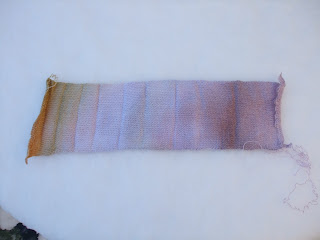
For sushi roll 1 I used more dye, but only 4 colours: sungold, flame, moss and mahogany

 Sushi roll 2 also had colours: Purple, Coral, malachite and marine blue. It also had twice as many 5-minute bursts of microwaving. Better, but still more muted colours than I would like.
For my next dyeing experiments I will try soaking the knitted strip (with and without vinegar in the water) and then applying dry dye powder...... watch this space!
Its not an original idea - I should give credit to Jon 'easyknitter' Dunne who creates gorgeous individualy dyed yarns. Check out the easyknitter website....
I decided to have a go at making sushi rolls myself when a) friend gave me an old knitting machine and b) I aquired a large cone of very fine white yarn of unknown fibre content, for £1 in a charity shop. The third necessary element (time) was supplied courtesy of yet more snow making it impossible to go and visit my stepfather in Oban (again).
First step: getting the knitting machine to work.
My mum had a similar machine, rather more basic, in the 1970's, and I had some vague memories of how to use it.Luckily my friend had also given me the instruction manual, so once I had given the machine a fairly cursory cleaning I followed the setting up instructions (with some trepidation) and gave it a go - bingo!! It worked perfectly!!!
Next step: figure out how much yarn to knit for each sushi roll. As the rolls are usually made for knitting socks, I figured that the length of yarn in a ball of sock yarn should be the minimum to aim for - 420 m in 100g ball of Trekking.
My white yarn was much finer than sock yarn, so I based all my calculations on using it double.
As long as each sushi roll contains 130g double yarn (before dyeing) there should be more than enough to knit a pair of socks, or any other project that can be knitted from a 100g ball of a standard sock yarn.
Winding the yarn was a fairly time consuming and tedious process, but the knitting went fairly quickly. It must be good exercise for the upper arms and pecs - bye bye bingo wings!!
I knitted 4 strips to experiment with -

Imagine how long that would take to knit by hand - each one took about 20 minutes on the knitting machine!!
I also knitted a mini sushi strip as a sample = first for pressing, then for dyeing.
The stocking stitch strips had a tendency to roll in from the edges, so I had to press them so they would stay flat for painting on the dye.
The exciting bit - dyeing!
I started my dying experiments with the skein of yarn I had wound for teting the weight. After soaking it I put a stock solution of Kemtex acid dye (blue) on one end of the skein. and some powdered Omega (all in one) dye in Coral on one part and Malachite on another part. I put a little boiling water over the dye powders, and then wrapped the skein in clingfilm.
I use an old microwave for dyeing small quantities - it is very temperamental and I never stay in the room while it is on as I'm sure it leaks microwaves, but it is preferable to using the one I cook in!
I gave the skein a couple of 5-minute blasts in the microwave and then left it to sit overnight.
When I took it out the skein appeared purplish blue all over, but as I rinsed it almost all of the lue rinsed away, leaving a pink shade with occasional bluish flecks. So - the Kemtex didn't appear to have taken.
The cotton string that I had used to tie the skein had dyed dark purplish blue, with some aubergine-purple bits. Thius suggests that the white yarn is not cotton, although it looks and feels like mercerised cotton.
Second dye test - the knitted sample strip
I made up stock solutions of 9 colours of Omega dyes, then put a line of each colour in turn on to the (soaked) knitted strip, leaving a white space between each.

After mocrowaving the colours looked promising, but a lot rinsed out. Also, the mahogany seemed to have spread, muting the colours
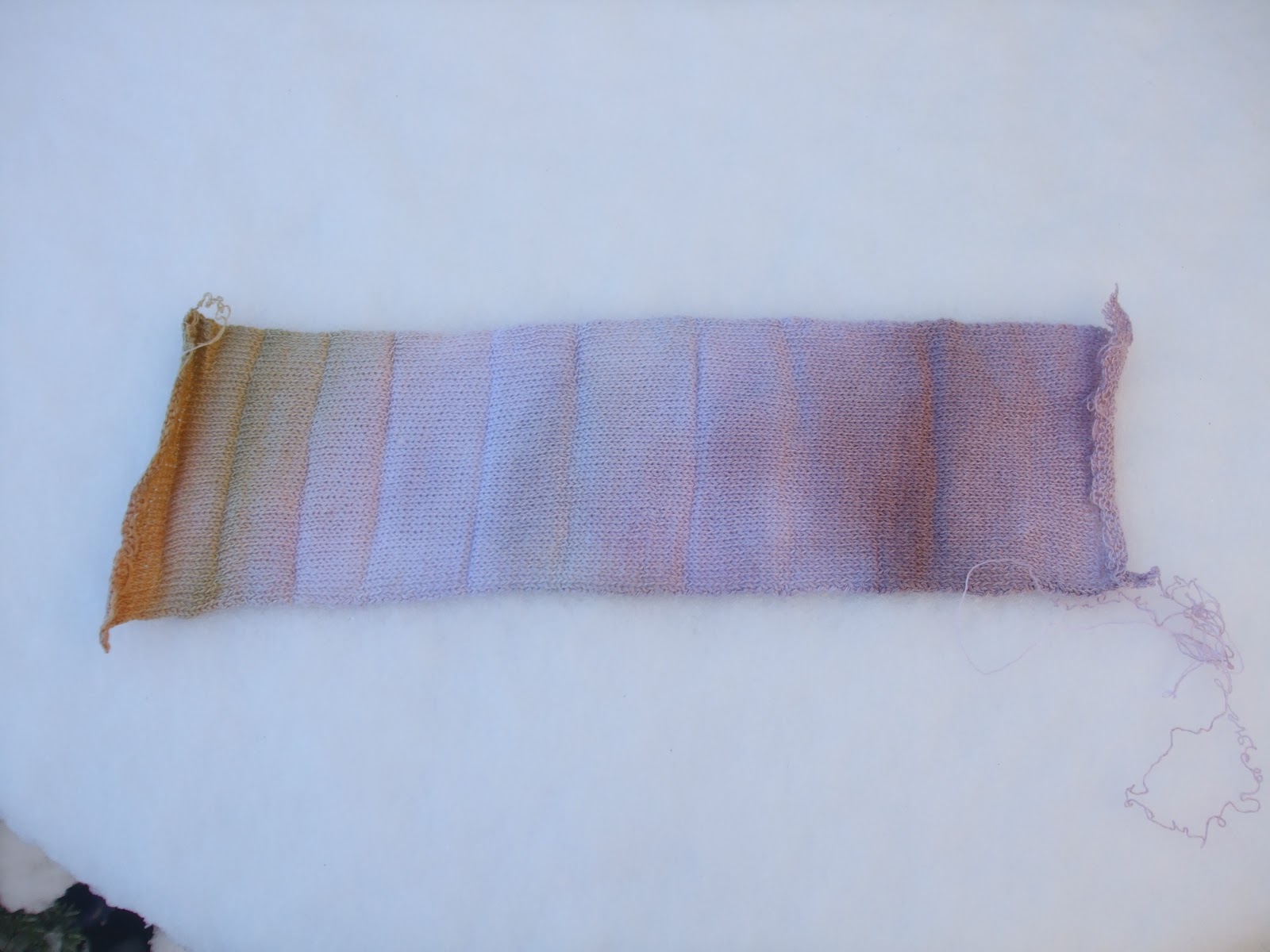
For sushi roll 1 I used more dye, but only 4 colours: sungold, flame, moss and mahogany


For my next dyeing experiments I will try soaking the knitted strip (with and without vinegar in the water) and then applying dry dye powder...... watch this space!
Wednesday, 5 January 2011
What weather!!
Friends and family from elsewhere in the UK and abroad have seen our little town of Auchterarder mentioned in news reports about the extreme weather we have been having, and it certainly is the main topic of conversation here!

The snow started on 26th November, by the 27th we were already cancelling journeys (I was meant to be going to the opera in Edinburgh) and for the next week or so our little town was intermittently cut off, cars buried under 2 feet of snow, no deliveries to the shops or petrol station so no milk, bread, veg, fresh meat etc and eventually no diesel (the only cars that could get about were 4x4s so they used up all the diesel but the petrol cars were mostly stuck!)


 In the first two snowy weeks I only managed to get to work once, but I can do a lot of my work from home and anything that would have required my physical presence had been canceled anyway. The following week was more or less normal, although as there are still great piles of snow (now frozen solid) in all the parking places a car is becoming a liability. Then the already low temperatures plummeted - in the week before christmas it was down to minus ten during the day and minus 18 at night. At those temperatures the salt that they put on the roads no longer melts the ice and we were cut off again several times, by lorries jack-knifing and blocking the roads. Much of the UK has been affected and it has caused all sorts of problems, not just with transport but things like postal services have been badly disrupted, at their busiest time. However Auchterarder does seem to be getting a reputation for snow!!! Our local council must be getting plenty of practice at dealing with it, because our main road and pavements were kept in a much better state than surrounding places I have visited lately.

As the snow started to melt we had icicles hanging from the roof that were as thick as my arm and about 4 feet long.

I got home from work one evening to find the fire engine, blue lights flashing, outside my house (rather alarming to say the least!) and a fireman up a ladder chopping down the icicles in case they fell and hit someone walking on the pavement in front of the house. It took them over 4 hours.
On Christmas Day the weather was dry, although bitterly cold and we managed to drive the 92 miles over to Oban to see my stepfather. It was very icy on the pavements there although the roads were clear - because it is on the coast Oban gets relatively little snow and they clearly aren't used to having to clear the pavements the way they do here. As we got back from our hotel christmas lunch the sun was just setting over the bay, which was like a mirror as there was no wind.

On the way home that evening the roads were covered in snow and slush between Loch Awe and Killin, but we got home ok.
The main roads are more or less clear now - we did have another two or three inches of snow on boxing day, once it had got a bit warmer, and it has snowed again this afternoon, with more forecast. Where the snow as not been disturbed there is now a solid frozen layer about 8 inches deep which will take some time to melt - we are getting up to about 3 degrees during the day now!!
Thankfully we have (so far) not had problems with frozen pipes - lots of people have. You can see from earlier posts that, while it has been very difficult and dangerous for anyone who has had to travel, even snow-clouds have a silver lining - it has been perfect weather for spinning and knitting!!!

Better not to drive at all!!

I think it's mine!!!
At first it was fun to go out for a walk, and the views were spectacular (especially the warm soup or hot chocolate after coming home!) but after a few days it got too difficult to walk through the snow just for fun, and going to see what the shops didn't have in stock became a local pastime.


Hamish doesn't like snow! Not 2 feet of it anyway!
As the snow started to melt we had icicles hanging from the roof that were as thick as my arm and about 4 feet long.

I got home from work one evening to find the fire engine, blue lights flashing, outside my house (rather alarming to say the least!) and a fireman up a ladder chopping down the icicles in case they fell and hit someone walking on the pavement in front of the house. It took them over 4 hours.
On Christmas Day the weather was dry, although bitterly cold and we managed to drive the 92 miles over to Oban to see my stepfather. It was very icy on the pavements there although the roads were clear - because it is on the coast Oban gets relatively little snow and they clearly aren't used to having to clear the pavements the way they do here. As we got back from our hotel christmas lunch the sun was just setting over the bay, which was like a mirror as there was no wind.

On the way home that evening the roads were covered in snow and slush between Loch Awe and Killin, but we got home ok.
The main roads are more or less clear now - we did have another two or three inches of snow on boxing day, once it had got a bit warmer, and it has snowed again this afternoon, with more forecast. Where the snow as not been disturbed there is now a solid frozen layer about 8 inches deep which will take some time to melt - we are getting up to about 3 degrees during the day now!!
Thankfully we have (so far) not had problems with frozen pipes - lots of people have. You can see from earlier posts that, while it has been very difficult and dangerous for anyone who has had to travel, even snow-clouds have a silver lining - it has been perfect weather for spinning and knitting!!!
Tuesday, 4 January 2011
Spinning classes - Scotland and Italy
The main purpose of this blog is to post details of my spinning classes. I've been spinning for over 30 years and teaching spinning for more than 25.
As new classes here (Scotland) or in Italy are planned, I will post details on this blog
I can teach basic spinning to absolute beginners, or tailor a more advanced class to the interests of the participants, covering anything from selection and preparation of fibres, blending, controlling thickness and twist, creating 'designer' yarns, plying techniques, finishing yarns and how to use handspun yarns.
I can also organise dyeing and felting workshops
I run a series of classes for adventurous knitters called 'Knitting beyond the printed pattern'
I offer spinning and knitting classes in my home in Perthshire, either one-to-one or small groups (maximum 5).
I can find a venue locally for groups of 5 - 12
I'm also happy to travel and run a workshop for up to 12 people - or for larger spinning groups such as guilds
When there is enough demand I offer a course of 10 weekly evening classes through the Auchterarder Adult Education Association - see http://www.aaea.org.uk/
If you would like information on costs, or any other aspect of my classes, leave a comment with your contact details and I will get in touch.
In 2010 I ran my first drop-spindle spinning class in Italy. Look out for a post about this very soon. I am now planning a series of spinning workshops in different locations in Italy, probably in April and September/October 2011. Watch out for more details of these posted on this blog, and on the Filare a mano - Italian handspinners group on http://www.ravelry.com/ .
If you would like to learn to spin, or learn some new techniques to enhance your spinning and knitting, I'd love to hear from you.
As new classes here (Scotland) or in Italy are planned, I will post details on this blog
I can teach basic spinning to absolute beginners, or tailor a more advanced class to the interests of the participants, covering anything from selection and preparation of fibres, blending, controlling thickness and twist, creating 'designer' yarns, plying techniques, finishing yarns and how to use handspun yarns.
I can also organise dyeing and felting workshops
I run a series of classes for adventurous knitters called 'Knitting beyond the printed pattern'
I offer spinning and knitting classes in my home in Perthshire, either one-to-one or small groups (maximum 5).
I can find a venue locally for groups of 5 - 12
I'm also happy to travel and run a workshop for up to 12 people - or for larger spinning groups such as guilds
When there is enough demand I offer a course of 10 weekly evening classes through the Auchterarder Adult Education Association - see http://www.aaea.org.uk/
If you would like information on costs, or any other aspect of my classes, leave a comment with your contact details and I will get in touch.
In 2010 I ran my first drop-spindle spinning class in Italy. Look out for a post about this very soon. I am now planning a series of spinning workshops in different locations in Italy, probably in April and September/October 2011. Watch out for more details of these posted on this blog, and on the Filare a mano - Italian handspinners group on http://www.ravelry.com/ .
If you would like to learn to spin, or learn some new techniques to enhance your spinning and knitting, I'd love to hear from you.
Subscribe to:
Posts (Atom)