Pages

Sunday, 8 April 2012

Colourful months part 2 - March


some
Another month, another workshop with the Online Guild of Weavers, Spinners and Dyers, this time Medieval Dyeing with Deb Bamford. I've done a lot of natural dyeing over the last 30+ years, but never in a very systematic way, so I thought this workshop would be a good opportunity to get some tips for improvement and also try to be a bit more disciplined in recording my efforts.
We started several weeks before the workshop proper, by preparing copper and iron solutions to use as modifiers. I put rusty nails in one jar, and some copper wire in another, topped them up with half-and-half vinegar and water, put the lids on and left them in a sunny place.

The third modifier was ammonia - traditionally stale urine was used, but I decided that was taking it just a tad too far and bought a bottle of ammonia from the ironmonger!

The materials: I chose parts of two fleeces - a fine white crossbred fleece and some Shetland that I had already (rather unsucessfully) solar-dyed with an exhaust bath of Cutch waste to a pale beige. I also used some Blue-faced Leicester tops, silk hankies, degummed cocoons, broken silk tops and silk noil tops, cashmere/silk blend tops, a skein of lovely soft cashmere yarn (commercially spun) and  small skeins of handspun silk and wool yarns. Finally, I experimented with dyeing batts of drum-carded (washed) wool
 I prefer to dye fibre rather than yarn or fabric for several reasons: I'm a spinner and occasional weaver so I'm not particularly interested in dyeing commercially spun yarn or fabrics - although I do make some exceptions to this; if the results aren't good I havent wasted the effort of spinning/weaving; if the dye takes unevenly on yarn or fabric there's not a great deal you can do about it - on fibre the dye pretty much always takes unevenly but you can then choose whether to exploit that to get a subtle variegation in the yarn, or blend thoroughly before spinning to get more homogenous colours. And of course you can blend the fibre from two or more dyelots to improve the shade or get a more useful quantity.
So I was starting to deviate from the workshop instructions before really getting started as Deb had recommended using yarn or fabric - which certainly run less risk of felting. Also commercially prepared fibres, spun or un-spun, seem often to take up dye better - I guess that the commercial scouring methods leave the fibres more porous than even a thorough washing at home.

That brings us to the first stage of preparation. I had already washed the fleece pretty thoroughly using washing soda and hot water at least twice. The first set of instructions were about scouring - getting rid of any last traces of grease or dirt in the fibre. Using my late mothers jam pan (aluminium, but I was going to use alum mordant anyway), the batches of soaked fibre were gently heated and simmered with detergent:
The next stage was to mordant it. Mordanting helps the dye to attach to the fibre. Some mordants are very toxic but for this workshop we used alum, in small enough amounts that it should all have been absorbed on to the fibres. However it is important to always be really carefull!!

I kept the mordanted fibres wet, in large plastic boxes with lids, which is fine over a few days - any longer before dyeing and I would have dried them and then soaked them again before dyeing.

The first dyestuff was good old onion skins. because I've used this many times I thought I'd try it out on the pre-dyed Shetland wool. This dye is substantive, which means it doesn't need a mordant. I had been collecting the dry papery outer skins for a few weeks - they keep really well in a paper bag.
I used essentially the same method to extract  all the dyes: I put them in a pan and poured boiling water over them, then left them to soak overnight. the next day I boiled them for about an hour, and again left them to soak overnight. The onion skins were the only dye I didn't tie up in muslin, instead I strained them out of the dye liquor before I put the wet fibres in.

Again, roughly the same method for all the dyes - after removing the dyestuff and entering the wet fibres, I heated the dyebath very slowly to 80 degrees centigrade. This took about two hours. Then I kept it on  a very low heat, checking that it didn't go above 80, for an hour, before switching off the heat and leaving it to cool and steep for up to 24 hours.

The next stage was to take the fibre out and divide it into smaller batches to experiment with the different modifiers. I just split the onion-dyed fibre into two batches and rinsed one.

I added a few spoonfuls of the iron solution to the dye, until it changed colour, going much darker. Then I put the second batch of dyed wool back in and heated it gently for about 15 minutes (from cold). Then I rinsed and dried the fibre:
To keep track of all my samples I cut out tags from a plastic carton, and numbered them in waterproof marker pen. That way I could tie them on to the samples as soon as they came out of the dyebath, without them being spoiled by getting wet.

The next dyestuff was Weld. I followed the same extracting and dyeing methods, using wool that had been pre-mordanted with alum and cream of tartar. I then divided the wool into six batches and the dye liquor into three. These were modified as follows:
the first wool sample #3: no modifier
I added a couple of spoonfuls of ammonia to the first dye batch and put in one wool sample #4. heated gently for 10 minutes then rinsed and dried
I added a few spoonfulls of copper solution to the second dye batch, put in two wool samples and heated gently for 10 minutes then took out one #5 and rinsed and dried. added a couple of spoonfuls of ammonia, heated gently for 10 minutes then rinsed and dried the other sample #6
I did the same thing with the last dye sample but using iron solution instead of copper, giving me samples #7 (iron) and #8 (iron + ammonia)
You can see the dramatic effect of ammonia on the samples on the right. The water here in Perthshire may be quite acidic, the alkali really brings out the colour. Copper had less effect than expected - perhaps the solution wasn't very strong, but iron darkened and 'saddened' the colour.

Next up was Dyers Broom, using the same methods as for Weld, and with very similar results:
The samples without ammonia are all a bit disappointing so I will keep a tiny amount of each as a record and then put them all in a dilute solution of ammonia to bring out the yellows. Actually yellow is a colour I rarely use so once I have spun them I may well over-dye them with indigo to try for some greens - it will be interesting to see if the ammonia has an effect on that.

So with the yellow/greens out of the way it was time to move on to (for me) the more interesting dyestuffs: brazilwood and madder.  However I wanted to dye more fibre in the 'exhaust' dyebaths with these two so all the modifications were done with the modifiers diluted in warm water rather than in the dye liquor. Using otherwise the same basic methods and modifiers I got these colours from Brazilwood:
The transformation from peachy oranges to purples with the ammonia was almost instant and really dramatic The tips of the fibres had as always taken up more dye and with ammonia they went bright red against magenta, with iron and ammonia they were almost navy blue against purple.
 Silk did not seem to dye as well as wool with brazilwood:


For each of the 'exhaust' baths I re-boiled the muslin bag of dyestuff in the original dye liquor for an hour or two, then left it to steep for at least 24 hours.

the second Brazilwood bath gave these:
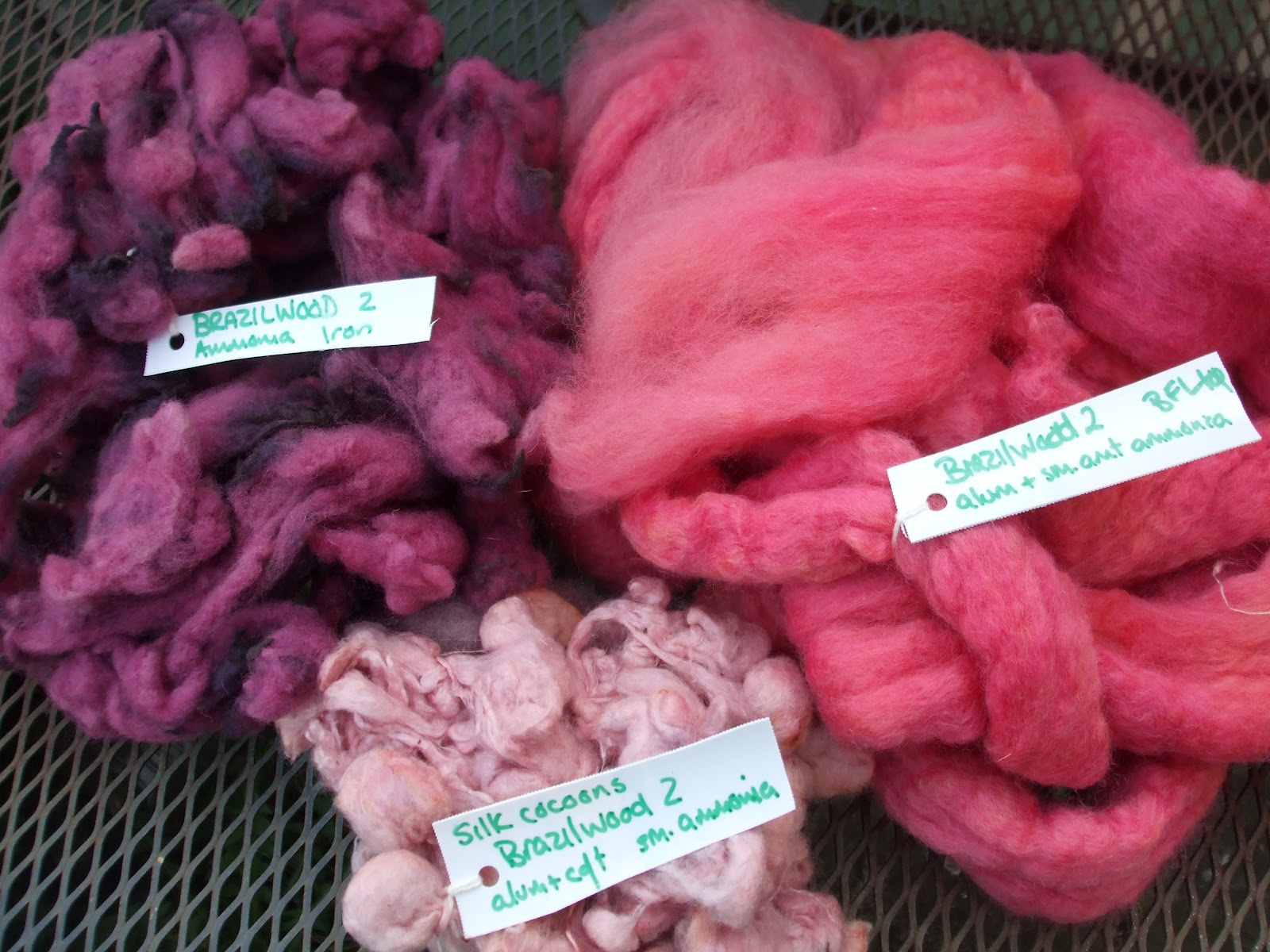
Top right: BFL tops, bottom; silk cocoons, both modified with a small amount of ammonia
Top left: fine crossbred fleece, modified with iron and then ammonia

A third 'exhaust' on drum-carded wool modified with iron and ammonia gave this blue

Madder was next, on fibres mordanted with alum but no cream of tartar as this is supposed to give better colours. Using the same methods as brazilwood gave:
There is a bit of silk top attached to #26 - no modifier The silk has taken up the colour well in places but is quite patchy. I also dyed some yarn samples and silk  in this dye bath, which were also a bit uneven.

In the second madder dyebath I dyed two batts of carded wool  which came out a good strong slightly brickish red, very even. Then I transferred the dye to an old copper pan and dyed the third batch, more carded wool, in it. I left it to steep overnight without stirring after the heating phase, and the final shade of the batt was quite varied, as some parts were touching the copper and some were not.

The pan had been quite tarnished (i think it has been in my garden shed for about 15 years!!) but after the dyeing the parts under the water level were much brighter so ther had clearly been some kind of reaction.

Even though I had only started with 100g each of brazilwood and madder, there still seemed to be a lot of colour left after three dyebaths, so I transferred the liquor and bags of dyestuff to large jars, added alum and fibre, for solar dyeing. They will sit on my windowsill for several months but already the fibres look as if they have taken up plenty of colour. I also set up a solar jar with un-used madder, for comparison - it s the biggest one, on the right.

As if I didn't have enough different dyes and modifications to try out, I also experimented with soome dried Hibiscus flowers from Turkey
These were actually sold for making a drink, mixed with cloves and chunks of ginger root and cinnamon bark. I picked out most of the spices but the simmering dyepot, and even the dyed fibre, had a subtle spicy aroma! In the first dyebath I dyed 50g of cashmere yarn and 50g of silk hankies
Not the rich ruby red of the dye liquor, but a very pretty shade, quite pink in some lights but more beige in others. The second dyebath gave a paler more beige shade on silk. All were pre-mordanted with alum and cream of tartar. I tried modifying tiny samples with both ammonia and vinegar but both seemed to make the colour less pink.

All together I dyed 44 samples over three very enjoyable weeks. I will probably leave the yellow/green dyes for those who appreciate those colors more than I do, but the range of pinks, reds and purples that I got has whetted my appetite for more dyeing. I have sown a tray of japanese indigo seeds in my greenhouse so hopefully by the end of the summer I will have enough to attempt some blues!! In the meantime I will enjoy spinning with colour for the next few weeks....

Colourful Months part 1 - February

The late winter months can really seem long and dreary, even though February is really the shortest month and the days are starting to get longer - so its a good time to inject a little colour!!

However long you have been practicing a craft you can always learn from other people so along with other members of the Online Guild of Weavers, Spinners and Dyers, I joined in Alison Daykin's  online Colour Blending workshop.

here's the picture I took as my colour inspiration:
I was interested in the colours in the water, and the rock, so I called the series 'Water and Rock' (original, huh?!!)

The plan was to blend a series of colours from fibres in primary colours plus black and white:
The natural black and white are Shetland wool, the dyed colours are merino

I was aiming to create the dark greenish khaki of the shadows on the water, a couple of greyish blues, and the more golden shade on the rock. I started with the khaki:
 First I started to blend yellow and blue and a little black to try for green. way too much blue at first, I added small amounts of each colour at a time, weighing as I went along, and ended up with 5 parts blue, 5 parts yellow, 6 parts black and 2 parts red - after many passes through my drum carder I got the yellow to 'sink in':
  Next, an attempt to replicate the shade but adding the final proportions of colours all in one go gave me this:
It is very difficult to weigh small amounts accurately with normal domestic equipment, so they arent exactly the same, but pretty close.

On to the grey blue:
On the next-to-last pass through the drum carder I added a few tiny 'pinches' of white silk tops to give lustre and highlights, here's the final batt:
This one has 6 parts blue, 8 white, 5 black and 1 red. It is a bit bluer than I had hoped, so I tried again, starting by making grey (15 white, 8 black) and then adding some blue (3) and a little red (1). Again I added some white silk near the end of the carding :
The two dark khakis plus the greyish blue and the blueish grey seemed to reflect the main shades in the water:
Now for the rock! The natural black Shetland, really a very dark brown, would fit for the dark areas so I just had the golden brown to try to replicate. 8 parts yellow, 4 black and 2 red turned out to be a good guess and I didn't make any further additions:


So after a full-on afternoon of weighing and drum-carding I had seven batts. The proportions of shetland to merino varied, but they were a joy to spin as they were so thoroughly carded. I spun singles which when 2-plyed gave a double-knitting thickness, in total I spun 445 metres (145g).

The presence of the Shetland has given the yarn more bounce and loft than merino alone would have had. Now I'm working up a design to use all the colours together, with a sense of the picture without trying to replicate it - watch this space!!!

Fancy trying this yourself? On May 20th I'm running a workshop called Playing with Colour where you can choose between this and two other techniques to put colour into your spinning - or felt-making. The workshop will be in Blackford Village Hall, (Perthshire) from 10 - 4 and costs £70. All materials provided. Drop me an e-mail to deborah.gray7@btinternet.com if you'd like more details.


Sunday, 4 March 2012

Monday, 20 February 2012

Happy Spinning Sunday

A craft shop full of colourful hand-made goodies, yummy cake and a group of people all keen to learn how to spin - my ideal Sunday afternoon, and that just about sums up the little workshop at An Cnoc, 31 East High Street, Crieff yesterday.
My 'teaching'spindles have whorls made from mahogany, 'recycled' from the last wooden fire engine used at Ardrishaig on the West coast of Scotland. A little bit of history that has now introduced many people to spinning

An Cnoc is the name of the craft shop, a real treasue trove of beautiful and unusual items, many made locally. Mandy, the owner, hosts a knitting group and a crochet group there, and as several of the members were interested in learning to spin, Mandy asked me to do an introductory workshop on drop-spindle spinning. We were joined by two ladies visiting Crieff for the weekend who I think had only found out about the workshop when visiting the shop the day before - an unexpected extra in their weekend away.
Working with drum-carded fleece lets the learners spend all their time spinning - but they don't learn how to prepare it, and guess who spends hours carding wool before the workshop!

With some complete beginners and a couple of spinners who use spinning wheels but wanted to brush up their spindle technique, it was a friendly and chatty group who quickly got to grips with spindles and some fleece that I had drum carded beforehand. Plenty of laughter and a generous supply of tea and cake (thanks Mandy!!) lightened the intense concentration as the learning progressed. By the end of the three hour session everyone had a skein of two-ply yarn that they had spun themself. I'm looking forward to seeing photos of the yarn after it has been washed - and to keeping in touch with this group.

Friday, 27 January 2012

First confirmed workshops for 2012 - and a special Fleece day in June

Here are the details for the first few workshops I have confirmed for 2012:

(for more details or to book a place please e-mail me - deborah.gray7@btinternet.com )
For a discount on workshops, look at the Special Offer with the Fleece On the Hoof Day

March 17th (Saturday) 1 - 4pm    Drop-spindle spinning      £36
Elena Costella's Yarn and Fibre Studio, Bridgend, Perth
Just what it says on the tin, 3 hours of drop-spindle spinning. Suitable for beginners or improvers. I will provide spindles and prepared fibre.


April 21st (Saturday) 10 - 4pm Fibre preparation and Drop-spindle spinning  £70
Blackford Village Hall, Perthshire (just off the A9 halfway between Stirling and Perth)
Starting with a whole fleece, we will learn how to sort the wool, recognising the different qualities of fibre. We will then cover hand carding and combing, and learn the difference between woollen and worsted yarns. We will also look at other fibres that are available to handspinners. After a short break for lunch (not included) we will spend the afternoon using drop spindles to spin and then ply. Suitable for beginners or improvers. All equipment and materials provided.

April 22nd (Sunday) 10 - 4 Spinning with spinning wheels   £70
Blackford Village Hall, Perthshire (just off the A9 halfway between Stirling and Perth)
This workshop is ideal for those who want to transfer their drop-spindle skills to a spinning wheel or who just want to improve their spinning wheel skills. We will spin singles yarns, and then learn why and how to ply the yarn, and how to 'finish' it. There will be a short break for lunch (not provided). Equipment and materials provided - £10 discount if you bring your own spinning wheel.

May 19th (Saturday) 10 - 4  Spin control       £70
Blackford Village Hall, Perthshire (just off the A9 halfway between Stirling and Perth)
This workshop is for people who have some experience of spinning, whether with drop spindle or spinning wheel. We will spin a variety of yarns, learning how to control thickness and twist to produce a balanced 2-ply yarn suitable for whatever project you have in mind. We will also explore some more unusual plying techniques that give different effects. There will be a short break for lunch (not provided). Equipment and materials provided - £10 discount if you bring your own spinning wheel.

May 20th (Sunday) 10 - 4  Playing with colour   £80
Blackford Village Hall, Perthshire (just off the A9 halfway between Stirling and Perth)
In this workshop we will be exploring different ways of blending colours - and fibres - to bring even more richness to handspun yarns. Subtle blends, colour gradients or wild and vibrant mixes - its up to you!! Please bring one or two shoe boxes (or similar) to take away your blended fibres. I will bring some drop-spindles in case you just can't wait to spin your blends, but if you want to use a spinning wheel please bring your own. There will be a short break for lunch (not provided). Equipment and materials provided - £10 discount if you bring your own drum carder.

May 26th & 27th   The Wool School, Miagliano, Italy
Content of this weekend will be developed according to the wishes of the participants; there will probably be one day for beginners and one for improvers. Contact me for more details

I'm still hoping to confirm dates for Grantown-on-Spey and County Wicklow, Ireland - watch this space

10th June (Sunday)                            Fleece on the Hoof       £10
Culdees Farm, Muthill, Perthshire
a great chance to select your fleece ‘on the hoof’, learn about how it was produced and then spin completely traceable local wool
After an informal (an optional) morning spin-together and bring-your-own picnic lunch we will have the opportunity to choose our fleeces - while they are still on the sheep!!
The Culdees flock are Texel cross sheep, they have a good medium staple length wool, fine springy fibres and little or no kemp. There is a significant proportion of Blue-Faced Leicester in the breeding and some of the fleeces definitely take after their grandad, having the long, fine, ringleted staples of BFL.
.  The young sheep with the best wool (nearly all white gimmers this year) will be gathered for us to choose from. Each sheep has an ear tag with a number, and when you have chosen your fleece, the tag number will be noted beside your name. The sheep will be shorn over the next few days and when you return to collect your fleece it will be labeled with your name. If necessary we can arrange to post fleeces but this will incur an extra charge.
Your £10 payment includes your first fleece; once everone has chosen a fleece if there are any left you can choose more for £7 each.
NB all proceeds from this event will go to the farmer, but places should be booked through me. PLACES ARE LIMITED SO PLEASE BOOK EARLY - YOUR PLACE WILL BE CONFIRMED ONCE YOU HAVE PAID

Special Offer!! if you hold on to half of your Fleece on the Hoof ticket, you can claim a £10 discount off the cost of one of my spinning workshops or a 3 hour session of 1-1 tuition (this offer is valid between 1st March and 31st August 2012 but excludes the workshop at Elena Costella) – and that is the cost of your fleece!

Tuesday, 10 January 2012

Colour change - in spinning

Anyone who has been a knitter or spinner in the last few years can hardly fail to have noticed the popularity of multicoloured yarns, and fibres. From subtle shading to vibrant contrasts, there's a wealth of variegation out there! Deliciously colourful skeins of yarn or tops and batts ready for spinning are very tempting, and the changes of colour add another layer of interest while we're working with the yarn or fibre, but the finished results are usually very different from the 'package' that tempted us so much .

Another time I will write about knitting with variegated yarns, but in this post I want to explore what happens when we spin multi-coloured fibres. The actual colours of the fibres don't change in the spinning and plying processes, but their appearance certainly does. Here are three examples:


singles
 A hand-dyed top where the colour is in bands across the top (this is Choc Choc Cherry merino & nylon from easyknits.co.uk). This kind of top is sometimes made into a braid when it is sold. 

2-ply
In the two-ply yarn there is a lot of 'barber's pole' where two different colours are plied together.
navajo-plied
In the navajo-plied sample there are more lengths of more-or-less solid colour  - by manipulating the length of the chain loops while plying it is possible to keep the colours more distinct.

In the second top the colours are blended along the length of the top - it is a mixture of merino and silk (from Ashfords I think!). You can see that (on the bobbins) in the singles yarn the colour is already more evenly blended


Once the yarn has been plied and knitted the colour is fairly homogenous while retaining some subtle variegation and occasional highlights of silk (ignore the 2-colour knitting in the top left of the photo)


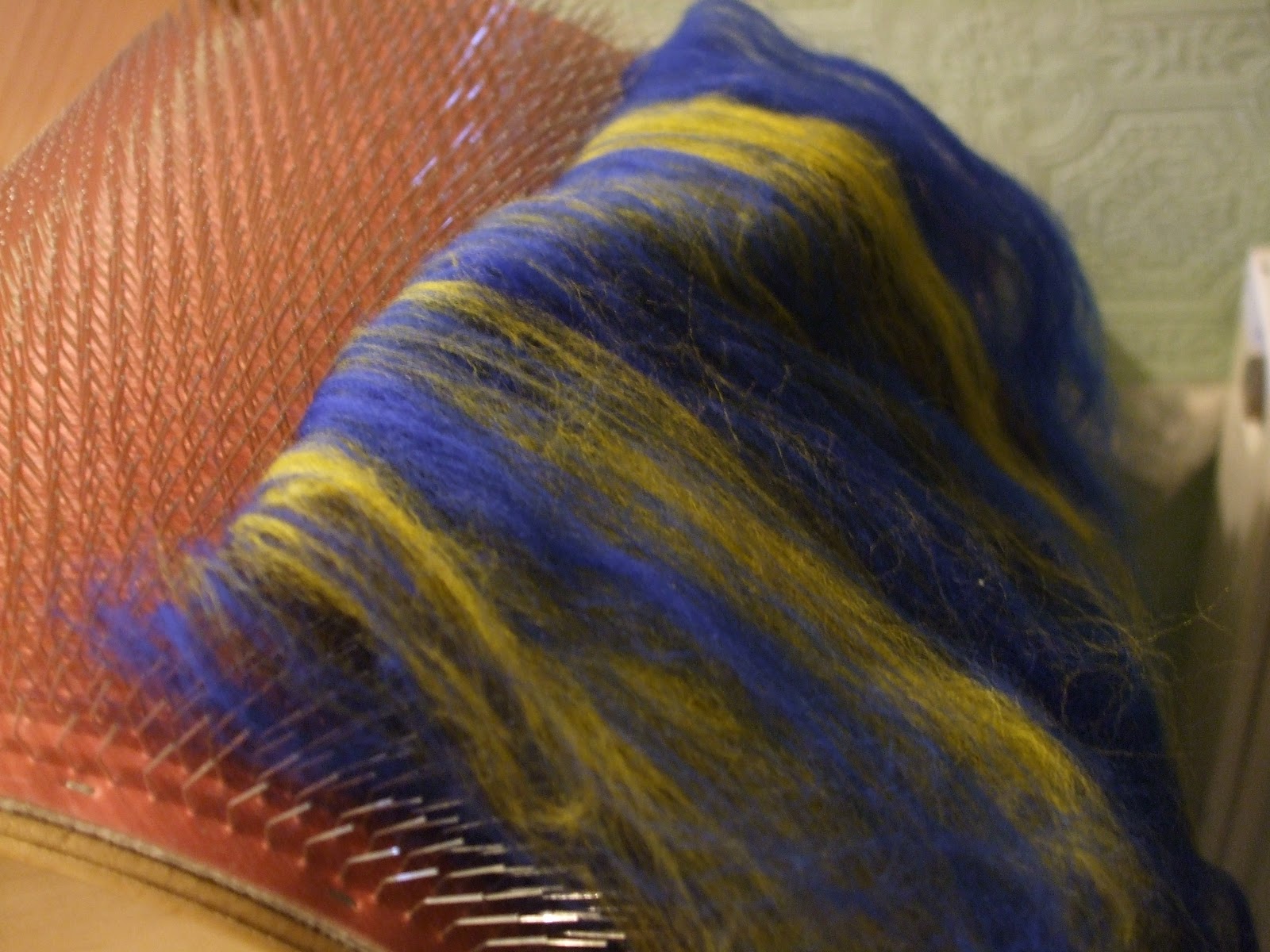
The third example is a hand-blended drum-carded batt - a mixture of various black and white wools (with a little sparkle, on the envelope, still to be added). So again the streaks of colour are along the length of the batt, built up in layers.

singles


The black and white yarn was intended for use as singles, to avoid further mixing of the colours. Any 'barber's pole' areas are where two colors of fibre are spun together without being blended. In order to 'set' the active twist the yarn had to be steamed and then dried under tension. The cowl that it was knitted into was worked in the round so that any remining singles slant, which will probably re-assert itself after washing, will have less effect.
Spinning technique
All three yarns were spun in semi-worsted style - in the same direction as the fibres were lying in the top/batt. I broke the tops into 20 - 30 cm lengths, slightly extended each one lengthwise to straighten the fibres, and then started spinning from the end. I didn't split the tops down their length or predraft as I find both of these techniques are usually not helpful, but doing so might have affected the way in which the colours were mixed. I did divide the batt lengthwise into a number of strips before spinning from the end of the strip. 

Spinning 'from the fold' - effectively dafting at right angles to the fibre length while holding the fibres folded over the index finger - would have mixed up the colours more, especially in the case of the carded batt.

The effect of plying
The merino-blend yarns were 2- plied, which further mixed the colours and where there was a lot of colour variation in the singles (the pink yarn) this led to a lot of 'barber's pole' areas.   Plying a variagated single with a solid colour single can give more distinct colour variations in the finished yarn especially if the shade of the solid colour single is close to one of the shades in the varigated one. Alternatively if a completely different colour is chosen, a 'barber's pole' with one colour varying is the result                                                     :

This is black cashmere plied with silk which has very long colour changes - it was spun fom hand-dyed silk hankies, predrafted to preserve the colour variation.


Friday, 6 January 2012

The Woolshed and The Wool School - November 2011

Just November and December to catch up with now!

November saw me heading north one dark and wintry night to Aberdeenshire, to deliver workshops at The Woolshed, Oyne. The Woolshed is a mecca for knitters in the north-east of Scotland, crammed full of gorgeous yarns including their own range of locally sourced wool in fabulous colours. There are patterns, needles and 'notions' galore, and loads to inspire whether you want to knit fine lace or chunky woollies - or anything inbetween.

Unfortunately I forgot to take any photos during the two days of spinning workshops there. We worked mainly in the Woolshed's conservatory but at times spilled out into the main shop area. With seven 'learners' each day plus, on Saturday, a large Leicester x Cheviot hogg fleece, and on Sunday seven spinning wheels, we really needed quite a lot of space!

On Saturday we spent a bit of time getting to know the aforementioned fleece, learning how to sort it into different qualities of wool - it was great to have sheep farmers Linda and Sarah there to add more information about keeping sheep and shearing them! (And look out at the end of this post for news about Fleece on the Hoof, an exciting idea which has grown out of that conversation!!!)

Once we had cleared the floor of the fleece (its amazing how much they spread when you unroll them!) we got down to carding and combing, discussing the differences between woollen and worsted yarns, and how it all starts with the method of preparation. We looked at other kinds of fibres - alpaca, mohair and silk for example - practiced blending on handcarders and preparing silk from cocoons and hankies. We also tried out different forms of commercially prepared wool.

After a delicious lunch of soup next door in Touched by Scotland we started spinning with drop-spindles. And once two small balls of singles were spun, we went on to plying.  By the end of the afternoon everyone had produced at least a few yards of hand-spun two-ply yarn, to take home, wash and proudly display.

On Sunday we turned our attention to spinning wheels. My four Ashfords (two Kiwis and two Traditionals) were supplemented by another Trad, a Traveller and a locally hand-made wheel. I was very impressed by the double-treadle Traveller, it is a huge improvement on the single-treadle one I got back in the early 80s, and I would have to concede that it is prettier than the Kiwi, although I really like the stability and robustness of the Kiwi.
We spun singles all morning, fortified by a delicious cake (thank you Patricia! What is it about cake and wool that makes such a perfect combination?!!!) and sampled the various fibres and blends that we had prepard the day before. After lunch at Touched by Scotland the singles were plied, and skeined, and we discussed washing and finishing the yarn, as well as how to measure thickness to determine knitting needle size or for comparison with commercial yarns. Again, everyone had at least one skein to take home, and plans were being made to meet up and spin together ....
Thanks to Barbara and the Woolshed staff for cups of tea and for hosting us for a very enjoyable weekend.

I was staying nearby with friends, so after packing up, Karen and I headed back for a delicious dinner - and just when I thought I couldn't stay awake any longer, Arne pulled out a box containing his grandmother's spinning wheel from the family's cabin in Norway. We tentatively tried to fit the various pieces together and after a few mistakes managed to figure it out - its not so easy when there are no instructions and you've never seen it in one piece!! Arne thinks that it was made by his great grandfather around 1870, from wood grown on the family farm, as in those days nothing was bought from outside that you could supply and make yourself. He is planning to restore it to working order - I would love to spin on it when he does!!

Having driven up in the dark and on the main roads, I drove home on the Monday morning via Braemar and Glenshee. Although the weather wasn't great, it was a nice journey through some really beautiful scenery. Shame I forgot my camera!!

When I got home I straight away had to start re-packing, as two days later I was off on my spinning travels again, this time to north-western Italy, to do two days of workshops as a guest tutor of the Wool School, see here organised by Biella The Wool Company.
BTWC is a consortium of wool processers  working to add value to wool - their products are completely traceable, using local breeds and producers all within a 10km radius. The Wool Box is their online shop, and the Wool School was devised to offer a series of courses delivered by practitioners who are very experienced in the various hand-crafts using wool. As well as my two days of spinning workshops there were courses on knitting and pattern design, felting, weaving and tapestry.

The courses complemented and ran alongside a fantastic exhibition called Wools of Europe, which has been touring major textile areas and was back at its 'home' in Miagliano from October to December. Over 100 european sheep breeds are featured, with a bag of raw fleece from each one, information about the origin and use of the breed, and examples of products made from the wool. A huge amount of work went in to putting the exhibition together and it is well worth seeing - hopefully it will continue to tour. The exhibition 'catalogue' is a fantastic reference book on european wool and sheep breeds in its own right

I arrived at Malpensa on Wednesday evening (no flight on Thursday, Friday's one too late for setting up) and was met by Emilio Langhi, one of the partners in BTWC, who had organised everything for my workshops. Emilio had also arranged a B&B for me in the little village of Pettinengo. It was of course completely dark as he drove me to Pettinengo, so I had no idea until I awoke the next morning that I was in such a pretty place!

Dawn over Biella, from m window in Pettinengo

My B&B was called Uva Fragola - strawberry grape - and they were gowing right there on my balcony, and made into jam on my breakfast table.

Pettinengo in daylight
I had the morning to explore Pettinengo before going to set up for the workshops.  It is a small village in the hills which evenually become the Alps to the north. It was very peaceful, not at all touristy and I really liked it.

The snowy alps

After a lovely lunch in a restaurant where I think we were the only ones speaking Italian - everyone else was speaking Piedmontese, Emilio took me over to Miagliano, where BTWC has its headquarters in an enormous woollen mill. The comune is one of the smallest in Italy, and really grew around the wool processing industry, sadly now all but lost. The big mill lay disused for about 20 years before the BTWC consortuium took it over, and there are workers houses, a school and infirmary all built to serve the workers and their families.
Emilio took me in to the big wool sorting shed - almost empty now as most of the wool for that year has been processed - and to select the fleeces for use during the workshop. I chose a whole Biellese fleece to show the variation in quality of the wool over the fleece,  but Biellese wool is a bit coarse for hand-spinning, so I chose some Sambucana and black Moretta d'Abruzzo for us to spin.
Biellese fleece
My workshop space was at one end of the big exhibition hall, so once I had re-built my Kiwi and organised the rest of my equipment I was able to have a good long look at the Wools of Europe exhibition.
On Friday I again spent the morning exploring, and also chatting with Corrado, who runs the B&B with his wife Alessia. Corrado first showed me a spinning wheel that he was repairing for someone - I think he said it had come from Sardinia, and the style was very similar to the one Anna had shown me in San Sperate, with a brake on the flyer and the drive band on the bobbin. Next he showed me a weel he had made himself, very similar to the Louet S10. In both cases I was able to suggest some minor improvements to help the wheels run more smoothly. Finally Corrado reached in to the wood store for the stove and produced a spindle he had turned, based on a local traitional design. He said it hadn't turned out well and he was going to burn it, so I could have it if I could spin on it!!
Corrado's hand-turned spindle
 Needless to say it has joined my collection of spindles, although more for curiosity value than practical use! With the weight centred so close to the shaft I find it hard to get it spinning and doesn't spin for long, but I'm sure with practice you could get used to it. I wonder whether this style was used for spinning canapa (hemp) which was the main non-wool fibre in the area.

In the afternoon Emilio took me to La Piccola Fata, a project based in a very old house in the village kitted out with antique school equipment, where children go after school to learn traditional crafts, the piedmontese language and traditions. First we visited the girls - about thirty of them aged from about 6 to 12, all wearing white pinafores and crammed on tiny chairs into a room with a hot woodburning stove. They were doing the traditional embroidery of the area, and singing. One girl showed me how she had learned to spin sardinian wool on her grandmother's (sardinian) spindle and short distaff. I had taken one of Murray's Scottish spindles and some Shetland tops so I did a little demonstration, and Emilio's daughter Emma told the other children about the Wools of Europe exhibition and the wool school. Next we went downstairs to where a similar number of boys were making woden christmas decorations. The volunteers showed me the woven samplers that the children make - a folder of 8 or 9 different weaves by the age of 9, moving from very simple frames to four shaft looms, and the traditional baskets and recycled wool fabric footwear that they make. The childen were all very focused on what they were doing, lively but very well behaved. I was very impressed!

The Saturday and Sunday workshops went really well, following a similar pattern to most of my weekend workshops with fleece and fibre preparation and drop spindle spinning on Saturday, and spinning wheel spinning on Sunday.
As always, everyone had different levels of experience and different wool and spinning stories, and we had some really interesting conversations. Also, throughout the workshops, visitors to the exibition came to see what we were doing, and Emilio explained the purpose behind the Wool School.
On Saturday night Rita was staying in the B&B - it was nice to have her company, as I was the only guest for the rest of my stay. She spent a couple of hours practicing her drop-spindle spinning while I knitted, and in the morning we had home made crema di castagna for breakfast as a special treat (instead of home made cake - different every day and also a treat!!).
On Sunday there were several spinning wheels to use and compare - but my Kiwi ended up going home to Brescia with Maria - where it will hopefully soon meet up with the Kiwi that belongs to one of my Lucca students, Rosaria, who also lives in that area.

This very ornate wheel is dated 1885
Again, the wheels were all of the flyer brake type - and again all needed some adjustments and plenty of oil to get them running smoothly, apart from the almost new Ashford that Laura brought with her.
On both workshop days we had lunch in the trattoria in Miagliano,
and a brief look around the village before going back to our spinning. I was amazed to see, opposite the mill, a Tennant's pub!!!


Monday morning arrived too soon and with it my flight back to Edinburgh. On the drive to Malpensa Emilio spoke of his hopes to continue and expand the Wool School - I certainly hope I can be involved in that!!

In December I did not hold any workshops, but it did see me picking up the conversation about fleeces that had started at the Woolshed. I called in to see Linda and her husband Colin (who only live about 5 miles from me) and between us we came up with an idea to let spinners choose their fleeces - while they are still on the sheep.
one of 2011's Texel cross fleeces to whet your appetite!
 We are calling this Fleece on the Hoof, and we plan to have a special day on the farm in June. I will post more details soon but places will be limited so if you are interested in learning more about it, let me know as soon as possible, by e-mailing deborah.gray7@btinternet.com.